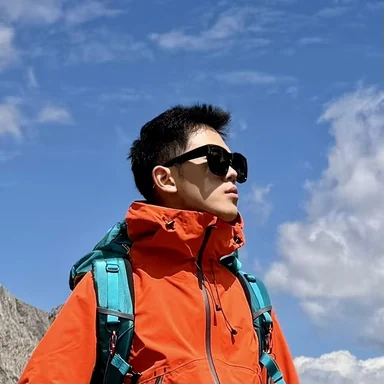
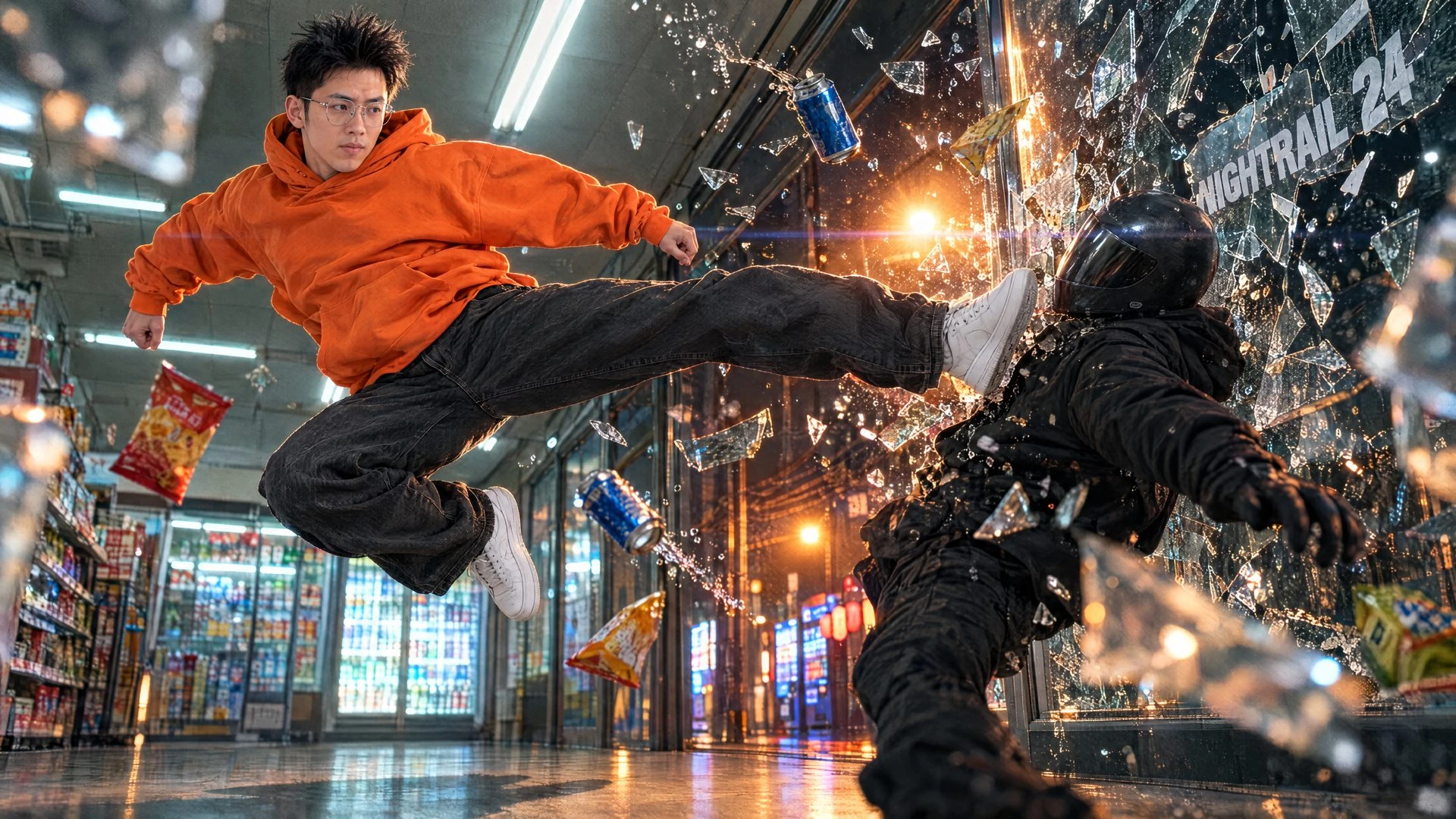
我讓 Claude 當導演,通過 Higgsfield MCP,做了一支由 Luke(AI 分身) 主演的動作預告《CUT》。觀看完整視頻,或打開 Higgsfield 原文中的動態生成卡片。
這篇保留了原文的 20 段英文生成提示詞、4 段操作指令、模型設置和輸入圖順序。網站裡的鏡頭畫面為截圖/組圖;動態片段和「重新創作」入口在 Higgsfield 原文。閱讀時間只估算流程正文,逐條研究長提示詞需要更久。
嗨,謝謝你看完視頻 ✨ 這裡是預告用到的全部提示詞,照視頻的順序排好,可以直接複製。
接上 Claude,先把故事定下來
- 在 Claude 打開「設置」→「連接器」,按「+」添加自定義連接器。
- 名稱填
Higgsfield,網址填https://mcp.higgsfield.ai/mcp,再按「添加」按鈕。

- 登錄 Higgsfield,按 Continue 授權。


- 再授權一個文件夾給 Claude。照片、圖片和視頻都存在這裡。
整部片的設定
- 片名:《CUT》。主角是 Luke(AI 分身),導演是 Claude。
- 故事:我被吸進 Claude 正在拍的動作片,它不斷給我安排危機。
- 三場戲:深夜便利商店的打鬥 → 雪原列車上的雪山巨獸 → 雨夜屋頂的武士對決。
- 結局:最後一刀劈下,畫面碎開,我回到書桌前。屏幕上的 Claude 問:「Cut. 這一條要重拍嗎?」
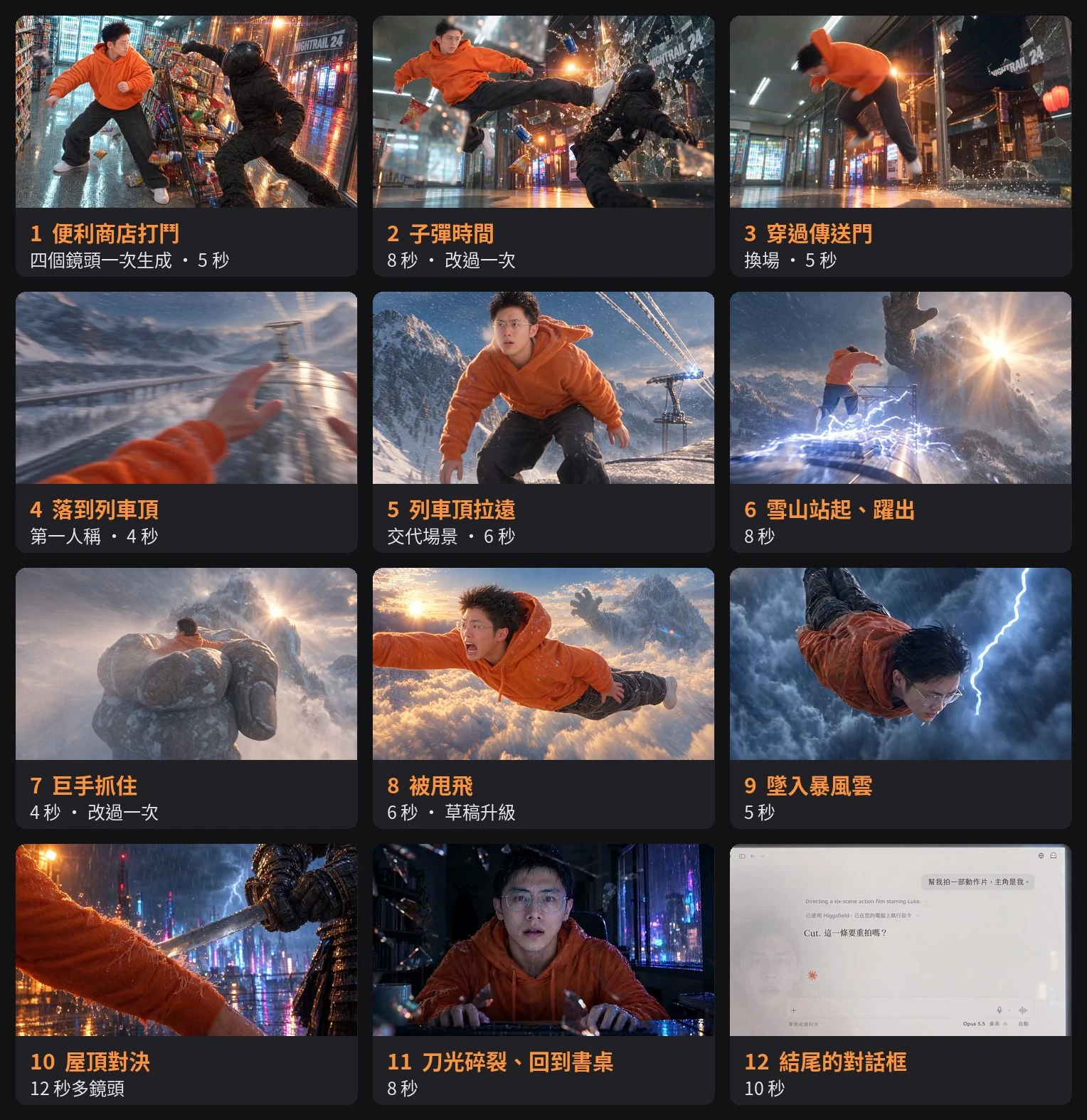
01|讓 Claude 寫導演計劃
「我想拍一支好萊塢風格的動作片,主角是我,最後要有反轉。」
「把每一場拆成鏡頭。每個鏡頭寫好圖片提示詞、視頻提示詞、片長和點數。」
Claude 會通過 MCP 查模型規格、試算點數,再交回逐格的分鏡和提示詞。這一步不花點數。
我放在 Claude 項目指示裡的完整內容
你是我的電影導演兼製片。我們用 Claude+Higgsfield MCP 製作《CUT》,主角是我。

先讀連接文件夾的「CLAUDE.md」及「素材清單.json」,按清單核對 11 張精修肖像、最新白底全身圖及服裝人臺,共 13 張 PNG。嚴格區分身份、人物全身外觀、服裝三種參考,不使用歸檔或舊 Soul 角色。

先以只讀方式核對 Higgsfield MCP 工具、照片上傳方式、目前角色、模型、分辨率及報價。不要立即訓練、上傳或生成。花點數前列明操作、參考圖、單價、張數、重試額度與總上限,等我確認。

圖片保持本人相似度、原發型、眼鏡與已採用頭身比例。同一套亮橘素面帽 T、長款深灰寬褲及白鞋。不要因舊圖分辨率較高而替換最新已採用版本。視頻先用核准的草稿設置,定稿另確認。

生成文件按鏡頭編號存入對應子目錄,每次在「生成記錄.jsonl」記錄 run_id、job_id、模型、提示詞、參考素材 ID、設置、預估/實際點數、結果網址與本機文件。失敗也記錄,無結果時先查找原工作,不重複提交。我實際送出的完整指令(導演計劃)
以下是實際送出的早期導演方案:當時按約 40 秒、21:9 規劃,後來鏡頭與結構已調整。它保留在這裡供參考,成片以視頻和上方分鏡總表為準。
現在進入導演階段。這一步不花點數:不要上傳、訓練或生成任何東西,也不要寫文件。只可以用 models_explore 查參數,以及用 generate_image/generate_video 的 get_cost:true 試算費用(只試算、不送出)。

【已確認的素材】
- 角色:Soul Cinema 角色 Luke,ID 〔你的角色 ID〕。只能用在 soul_cinematic、soul_2 圖片模型。
- 角色設定表:02_角色設定/CS01_四視圖_2K_v3.png(已採用)。
- 外觀比例與褲子顏色:02_角色設定/換裝_全身正面_白底_Imagegen2_已採用.png。褲子以這張的深炭灰為準,v3 的中灰不算數。
- 服裝:亮橘素面帽 T、深炭灰水洗寬褲、白色低筒鞋,沒有任何文字或 logo。兩個狀態:乾淨(書桌、便利商店、列車、飛行);溼透+右袖劃破(雨夜屋頂起,一直到結尾書桌)。

【故事《CUT》,約 40 秒,21:9】
我請你拍一部動作片,主角是我。我被吸進你正在拍的電影,每一幕換一種大片類型,最後回到書桌。
1. 0–3 秒:深夜便利商店,子彈時間的迴旋踢;玻璃碎片和零食停在半空。
2. 3–7 秒:時間倒回。凌晨書桌,我對 Claude 打字,按下 Enter。
3. 7–10 秒:屏幕光暴漲,我被吸進對話窗口;希區考克變焦(背景拉遠、人物不動)。
4. 10–14 秒:我落在便利商店,接上開場那一腳。
5. 14–18 秒:對手撞破玻璃,碎片化成暴風雪,匹配剪接到高速列車車頂。
6. 18–23 秒:我在列車頂狂奔、跳躍;身後城市巨獸站起。
7. 23–28 秒:巨獸揮爪,我從列車一躍而起,飛過城市上空。
8. 28–33 秒:落在雨夜屋頂,武士對決,刀刃相撞,慢動作。
9. 33–36 秒:刀光劈開畫面,整個畫面像玻璃碎裂,露出對話窗口。
10. 36–40 秒:回到書桌,我喘氣,衣服溼透、袖子破了;片名《CUT》。

【限制】
- 不出現真實品牌、招牌,或任何電影的角色、服裝、場景、臺詞。巨獸外型原創。飛行不穿戰衣。打鬥不見血。
- 屏幕上的文字、對話窗口內容和片名字卡,之後在剪輯時合成。生成畫面只需要留出位置,不要讓模型畫字。

【請你輸出】
1. 生成方法:Soul ID 不能直接用在 Seedance 2.5,請說明你怎麼讓每一格都是我。我的想法是:每格先用 Soul Cinema 生成 21:9 關鍵畫面,再交給 Seedance 2.5 當起始幀(轉場格加結束幀),同時附角色設定表當參考。如果你有更好的做法,說明理由。
2. 逐格表:編號、秒數、生成片長(模型最短 4 秒,短格先生成再剪)、關鍵畫面提示詞、視頻提示詞(含運鏡、動作、光線、聲音)、模型與模式、參考素材和它的角色(起始幀/結束幀/圖片參考)、分辨率、試算點數。
3. 點數:每格的關鍵畫面+視頻試算、480p 草稿總計、1080p 定稿總計,以及預留重做額度後的總上限。
4. 試跑建議:Step 5 只跑兩格 480p 草稿。我傾向第 1 格和第 3 格,其中一格再用 Cinema Studio 4.0 跑一次做對比。請確認或建議替換,並寫出試跑總點數。
5. 風險:哪些格可能被審核擋下(ip_detected、nsfw、打鬥)、哪些格最難維持人物一致,以及你的備案。

全部回覆在對話裡。等我確認後,才開始任何付費步驟。02|Luke(AI 分身)
1. 訓練 Soul ID
Soul ID 是 Higgsfield 的功能:用你的照片,訓練一個長得像你的 AI 人物。照片準備正面、左右轉頭、側面、抬頭、低頭,再加一兩張自然微笑。
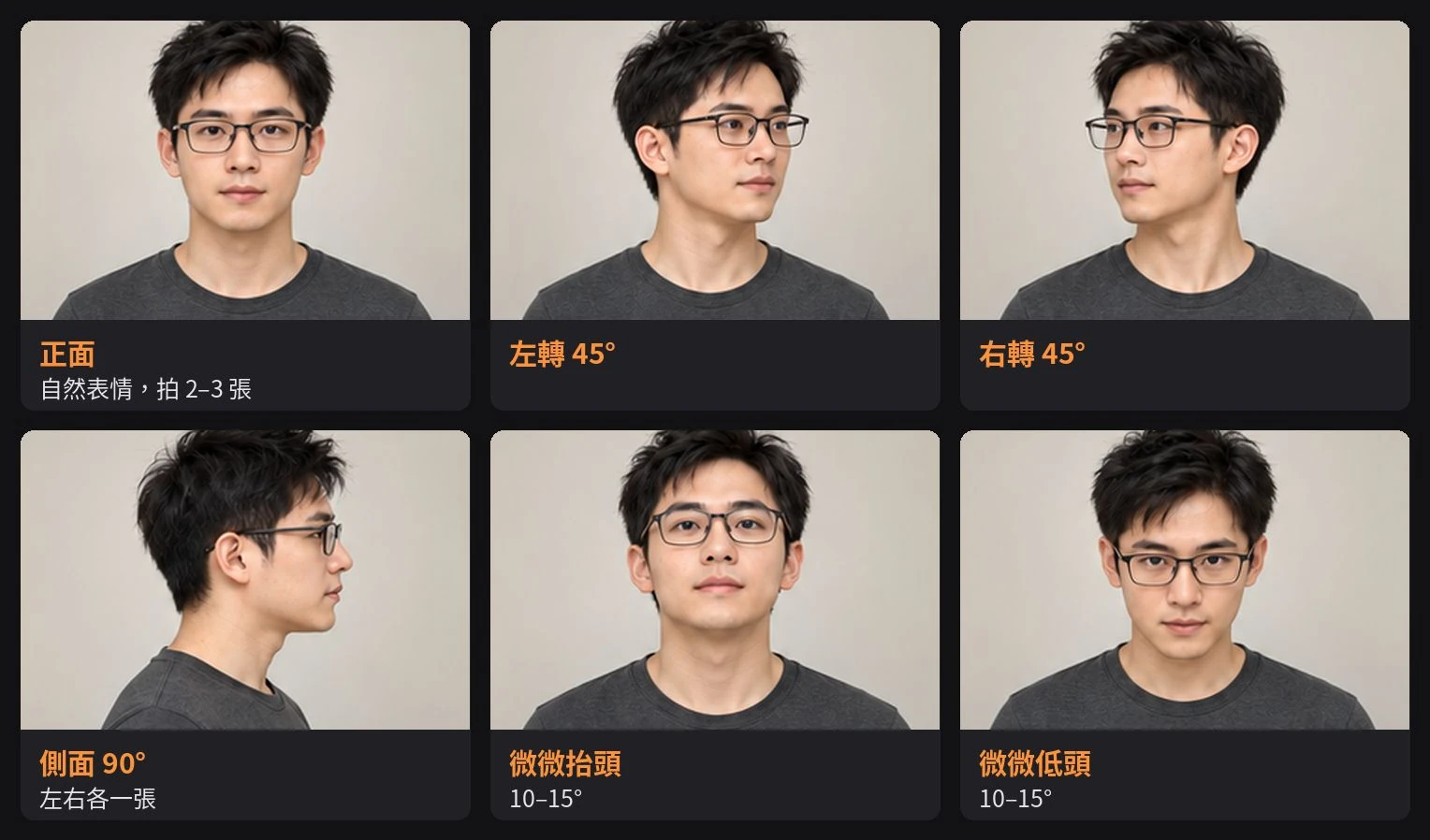
「用這些照片,幫我在 Higgsfield 訓練一個 Soul ID,名字叫做 Luke。」
我實際送出的完整指令
我的照片在連接的文件夾「01_我的照片」裡,一共 11 張,都是本輪已篩選的精修版。請你直接讀取文件,用這 11 張訓練一個新的 Soul Cinema 角色,名字叫 Luke,不重用帳號內的舊角色。完成後告訴我本輪新角色的 ID。2. 找穿搭、換裝
「你幫我找一下穿搭。」
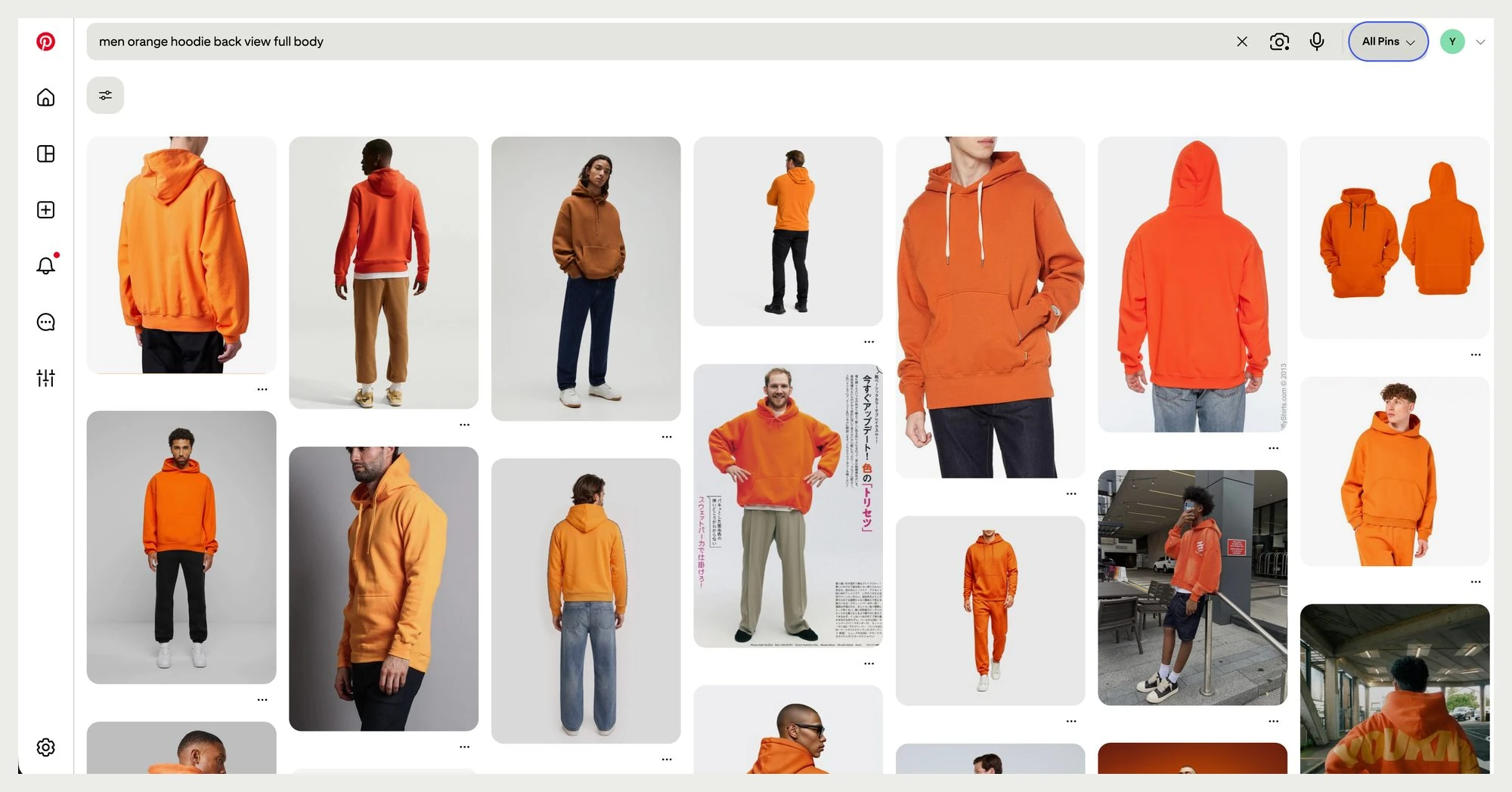
Claude 用 Claude in Chrome 打開我的瀏覽器,到 Pinterest 找參考。我選了 亮橘色帽 T、深色寬褲、白鞋:夜景和雪地裡都很好認。
「通過 Higgsfield,用我的人物和這套服裝,先做一張全身圖。」
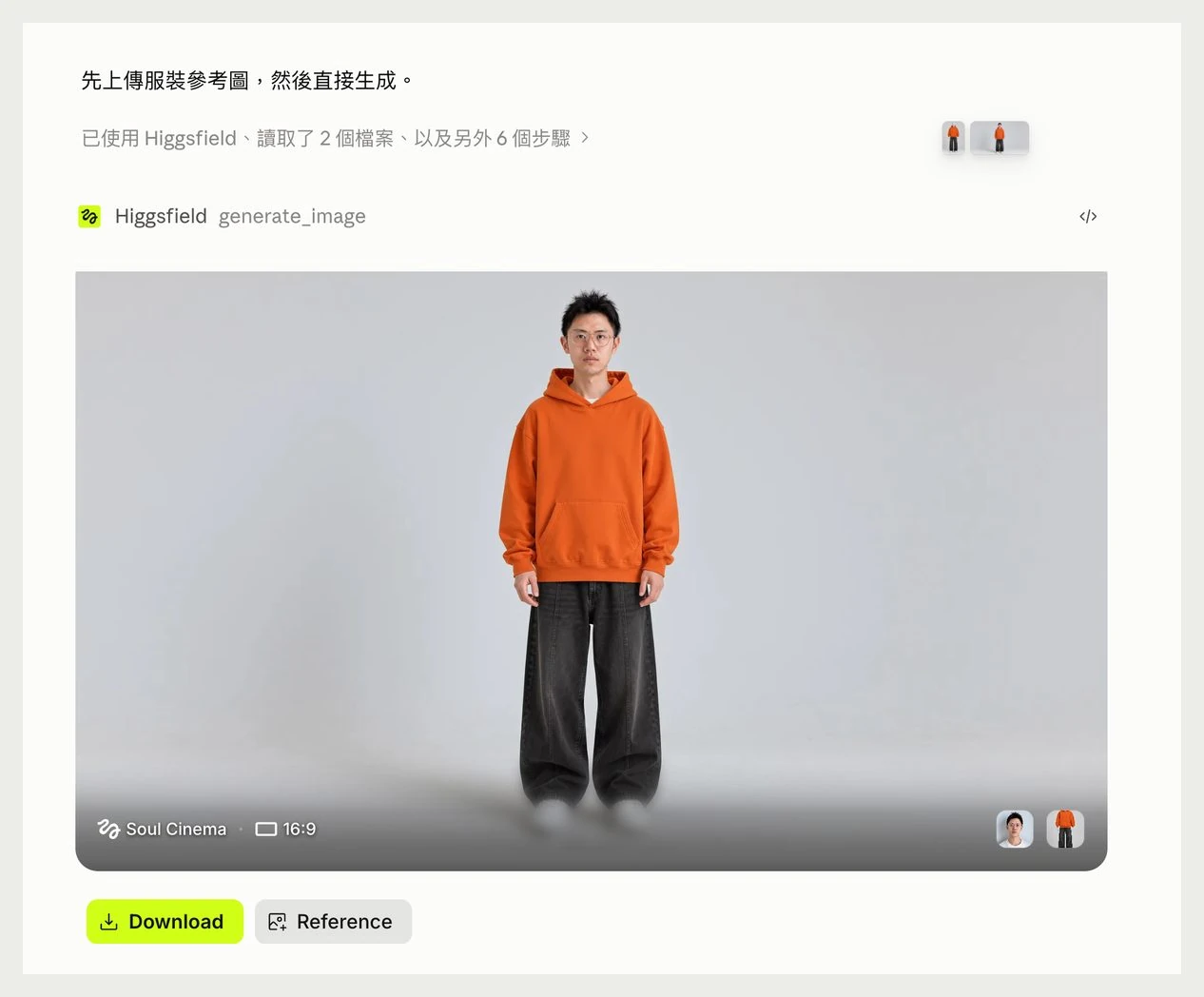
我自己這次的全身圖,另外修過比例和褲長。
3. 角色設定表
「通過 MCP,請 Higgsfield 按這個外觀生成角色設定表。」
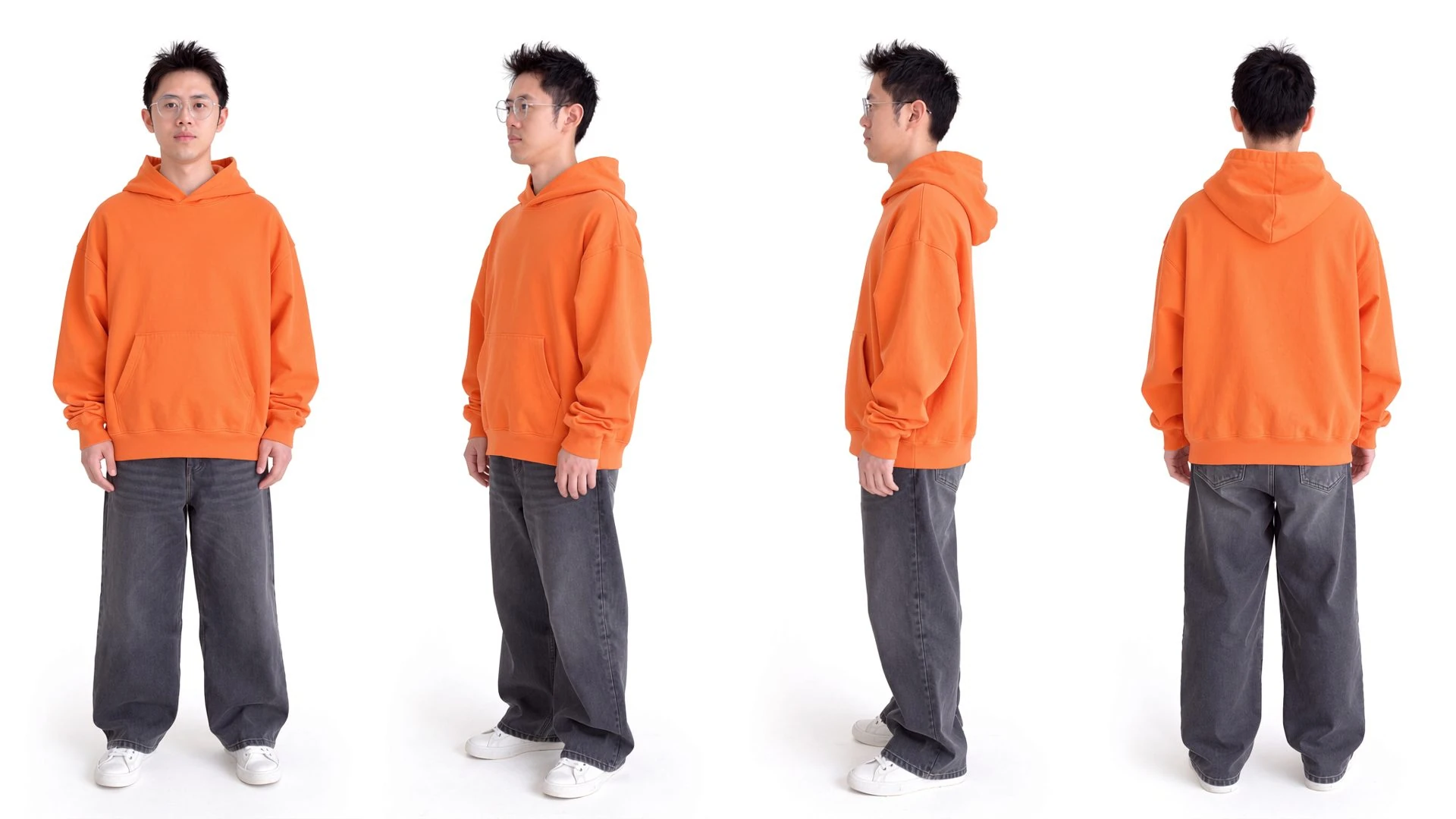
我實際送出的完整指令
本輪新的 Luke 練好後,用 Soul Cinema 和這次訓練完成的 Luke 角色,以本次返回的角色 ID 為準,參考「02_角色設定/服裝參考_人臺正面.png」這套衣服,生成一張角色設定表:同一個人,正面、3/4 側面、側面、背面四個全身視圖排成一排,白色無縫背景,柔和棚燈,寫實、保留自然膚質。戴他平常的細框眼鏡,保留原發型。亮橘色素面帽 T、深灰水洗牛仔寬褲、白色低筒球鞋,衣服上沒有任何文字或 logo。另讀「02_角色設定/換裝_全身正面_白底_Imagegen2_已採用.png」,按這張已確認的頭身比例及褲長製作,褲腳在鞋面自然堆疊。比例 16:9,畫質 2K。生成前先告訴我要花多少點數,我確認後再開始;如果指定設置不支持,先說明。完成後存到「02_角色設定」,保留現有兩張參考圖,並告訴我實際花了多少點數。角色設定表的提示詞
Wide shot character turnaround reference sheet: the same young East Asian man shown FOUR times side by side in one horizontal row, evenly spaced, small in frame so every figure is full body from top of hair to shoes. Figure 1: front view, body and face facing the camera. Figure 2: three-quarter view, body rotated 45 degrees to the right, both eyes and the front of the hoodie still partly visible. Figure 3: exact 90-degree side profile facing right. Figure 4: back view facing away. Seamless pure white studio background, soft even studio lighting, realistic photography, natural skin texture. He wears thin silver round metal-frame glasses and has short spiky black hair. Saturated bright orange plain oversized pullover hoodie with hood, kangaroo pocket, ribbed cuffs and hem. Dark charcoal-grey washed denim wide-leg jeans, plain, very long so the hems pool and stack over the shoes. White low-top sneakers. Natural adult proportions about 7.5 heads tall, relaxed neutral standing pose, arms at sides. No text, no logos, no labels, no watermark.03|第一場:便利商店
1. 關鍵畫面:飛踢定格
「用同一套提示詞,在 Higgsfield 上同時跑幾個圖片模型,讓我比較。」
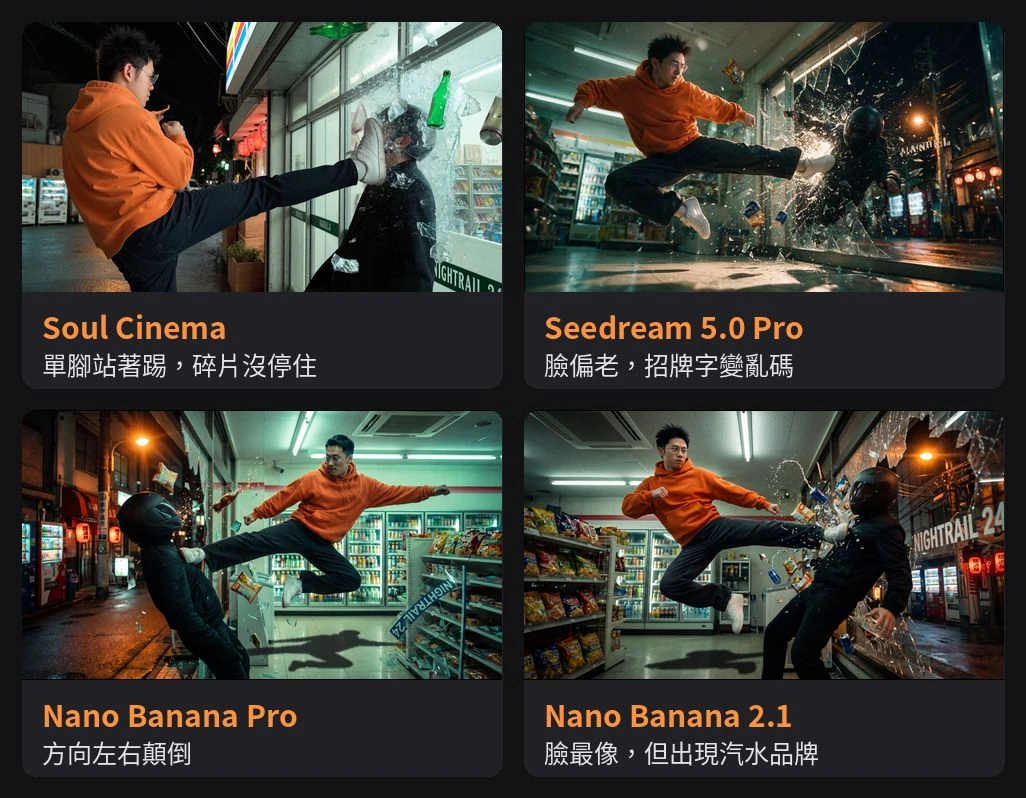
最後選了 GPT Image 2.5:騰空、碎片和逆光都到位。之後所有關鍵畫面都用它。
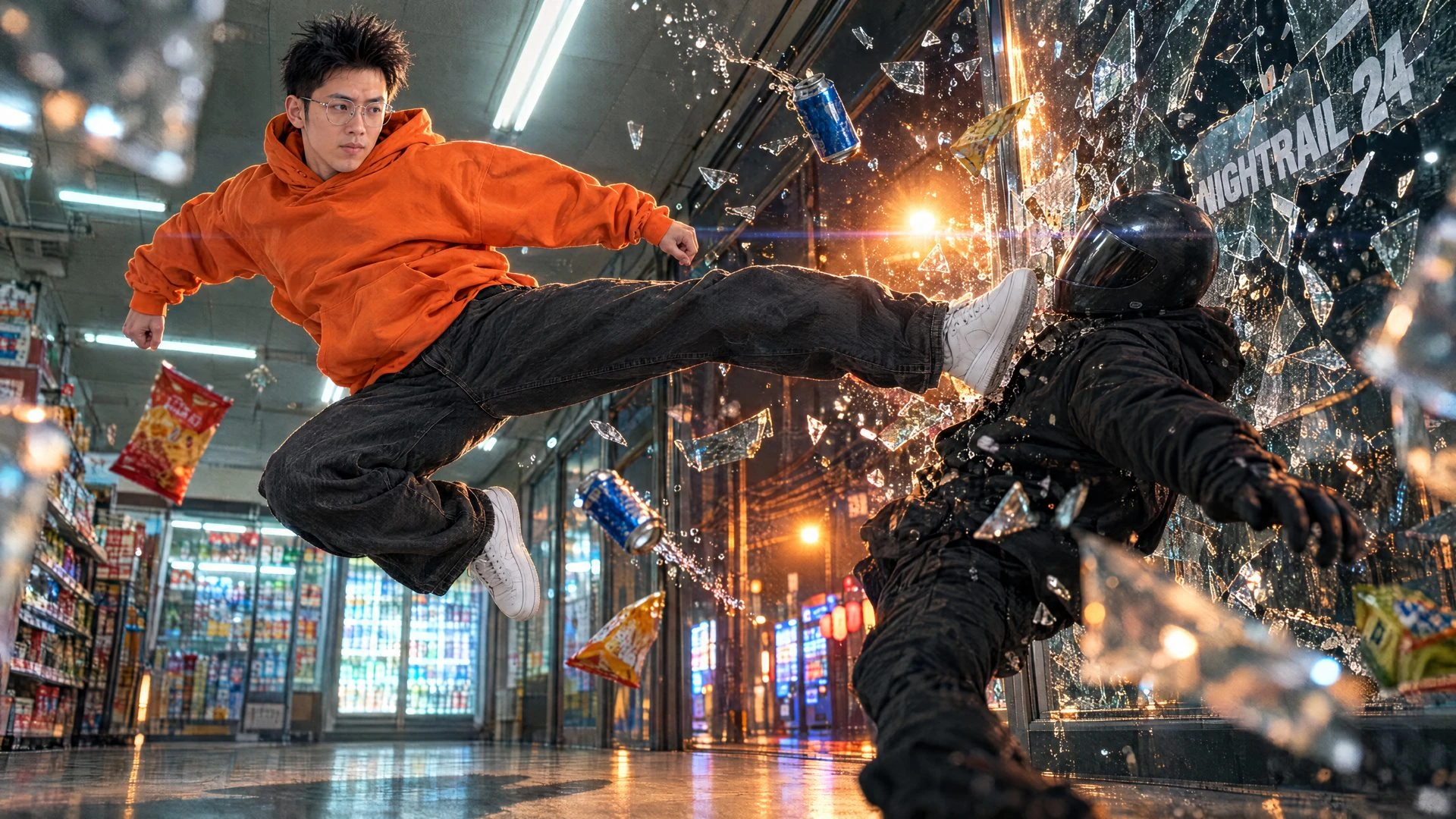
飛踢關鍵畫面的提示詞
Cinematic 16:9 film still, the peak frame of a bullet-time action sequence. 3 a.m., inside a small neighbourhood convenience store in a Japanese city. The man is the person in @Image 1, @Image 2, @Image 3, @Image 4 and @Image 5: keep his face, glasses, hairstyle and body proportions identical.

HERO MOMENT: a jumping side kick caught at its peak. Both of his feet are clearly off the ground: his tucked left foot hangs about half a metre above the floor, and his shadow falls on the floor directly below him, separated from his feet. His right leg is fully extended, the sole of his white sneaker driving into the chest of a helmeted attacker, who is blasted backward into the store window as the glass explodes. The instant of impact is frozen in time.

THE MAN: large in frame, filling the left half. Face in three-quarter view toward the camera, thin silver round metal-frame glasses, short spiky black hair lifted by the jump, eyes locked on the target, calm and controlled. Bright orange plain oversized hoodie, hem and sleeves rippling from the motion. Deep charcoal-black washed wide-leg jeans, the same dark colour as @Image 6. White low-top sneakers. No text or logos on his clothing.

THE ATTACKER: right third, smaller than the hero, matte-black full-face motorcycle helmet with a smoked visor, plain black jacket, arms flung out, his back breaking the glass. His face is never visible.

FROZEN IN THE AIR: a sphere of glass shards suspended around both figures, every shard catching light. A few colourful snack bags and blue soda cans hang mid-flight; one can sprays a frozen arc of droplets. The white window decal "NIGHTRAIL 24" splits apart across several shards. Large blurred shards sit right in front of the lens.

SETTING, simple and out of focus behind them: shelves of colourful packaging, a wall of glowing drink fridges, fluorescent ceiling lights. Outside the window: a narrow wet Japanese side street at night, utility poles with tangled overhead wires, a row of glowing vending machines, red paper lanterns of a small izakaya, an orange streetlight, all melting into bokeh.

CAMERA: very low angle, lens just above the floor, so the gap between his feet and the floor and the shadow beneath him are clearly visible. 35mm anamorphic lens, his body fills most of the frame height. One strong diagonal runs from his head along his extended leg into the attacker. Shallow depth of field at f/2, focus on his face and the point of impact.

LIGHT: the streetlight bursts in through the shattering window as a hard warm backlight, rim-lighting his hair, the hoodie and every shard. Cool green-white fluorescent fill from above. Light haze. Deep blacks, teal-and-orange contrast; the orange hoodie is the brightest colour in the frame.

LOOK: 35mm film grain, slight highlight halation, anamorphic horizontal flare, razor-sharp frozen detail.

AVOID: real store chains or brand logos, the colour stripes or signage of real Japanese convenience-store chains, readable text other than "NIGHTRAIL 24", blood, injury, the attacker's face, navy-blue jeans, black shoes, sunglasses, watermark.2. 打鬥:四張圖,一次生成四個鏡頭
「把這四張和飛踢圖串成一段視頻。生成前先列出片長和點數。」
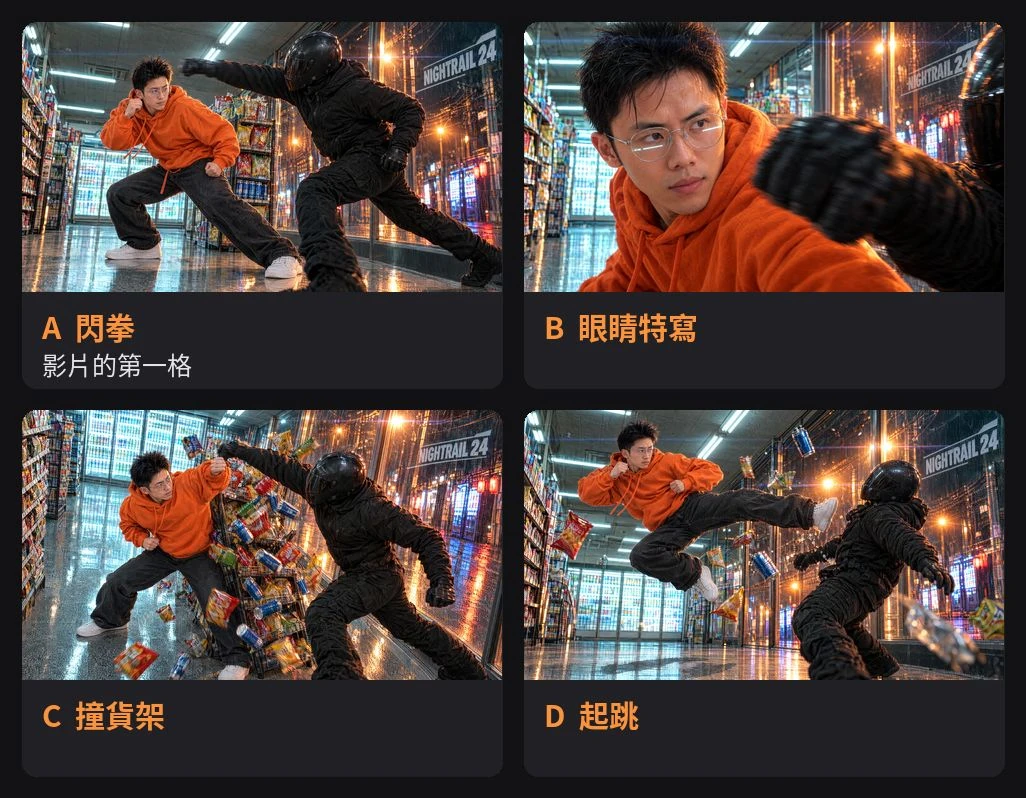
關鍵畫面 A 的提示詞(B、C、D 寫法相同)
Cinematic 16:9 film still, the opening frame of a fast-cut fight sequence. The same convenience store, the same night, the same lighting and the same helmeted attacker as in @Image 1, a few seconds earlier, before anything has broken.
FRAME: medium-wide, both fighters fully visible head to feet. The hero on the left third, the attacker on the right third, the punch crossing the centre of the frame. The intact front window fills the right background.
ACTION: the attacker lunges forward from the right, throwing a hard right hook at the hero's head, his whole body leaning into the punch. The hero slips sideways and down under the punch in a low athletic stance, weight on his back foot, left forearm raised in a tight guard beside his face, right fist cocked at his hip ready to counter. The fist passes a few centimetres above his head. His drawstrings swing from the sudden movement. Eyes locked on the attacker, calm and focused.
PROPS: between them, slightly left of the attacker, a freestanding display rack full of colourful snack bags and blue soda cans, still standing.
CAMERA: chest height, about 3.5 m from the hero at his front three-quarter, 28 mm anamorphic lens, a 5-degree Dutch tilt for tension. Focus on the hero's face and the attacker's fist. Only the attacker's swinging fist has slight motion blur; everything else is sharp.

IDENTITY: the hero is the person in @Image 2, @Image 4, @Image 5 and @Image 6. Keep his face, thin silver round metal-frame glasses, short spiky black hair and body proportions identical to the references.
THE HERO'S OUTFIT: bright orange plain oversized pullover hoodie, hood down; deep charcoal-black washed wide-leg jeans with long hems stacking over the shoes, the same dark colour as @Image 3; white low-top sneakers. No text or logos on his clothing.
THE ATTACKER: an adult man in a matte-black full-face motorcycle helmet with a dark smoked visor, plain black jacket, dark trousers, black gloves, exactly as in @Image 1. His face is never visible.
SET: a small 24-hour Japanese neighbourhood convenience store at 3 a.m. Densely stocked shelves of colourful packaging from fictional brands with no readable text, a back wall of glass-door drink fridges glowing cyan-white, rows of fluorescent ceiling panels, a grey speckled vinyl floor with a wet sheen. The large front window carries a white "NIGHTRAIL 24" decal. Outside: a narrow wet side street at night, utility poles with tangled overhead wires, glowing vending machines, red paper izakaya lanterns, an orange sodium streetlight.
SCREEN DIRECTION: the hero is on the left facing right; the attacker is on the right facing left; the front window is behind the attacker on the right.
LIGHTING: the orange streetlight comes through the front window as a hard warm backlight, rim-lighting both fighters' hair, shoulders and edges. Cool green-white fluorescent top light inside, cyan fridge glow as fill. Thin haze in the air. Deep blacks, high-contrast teal-and-orange grade; the orange hoodie is the most saturated element in the frame.
LOOK: live-action Hollywood action film, shot on 35 mm film, fine grain, slight halation on highlights, anamorphic horizontal flare from the fluorescent tubes, hyper-detailed, photorealistic.
AVOID: blood, injury, weapons, the attacker's face, readable text other than "NIGHTRAIL 24", real store chains or brand logos, the colour stripes of real Japanese convenience-store chains, navy-blue jeans, black shoes, sunglasses, extra people, distorted hands, extra limbs, watermark.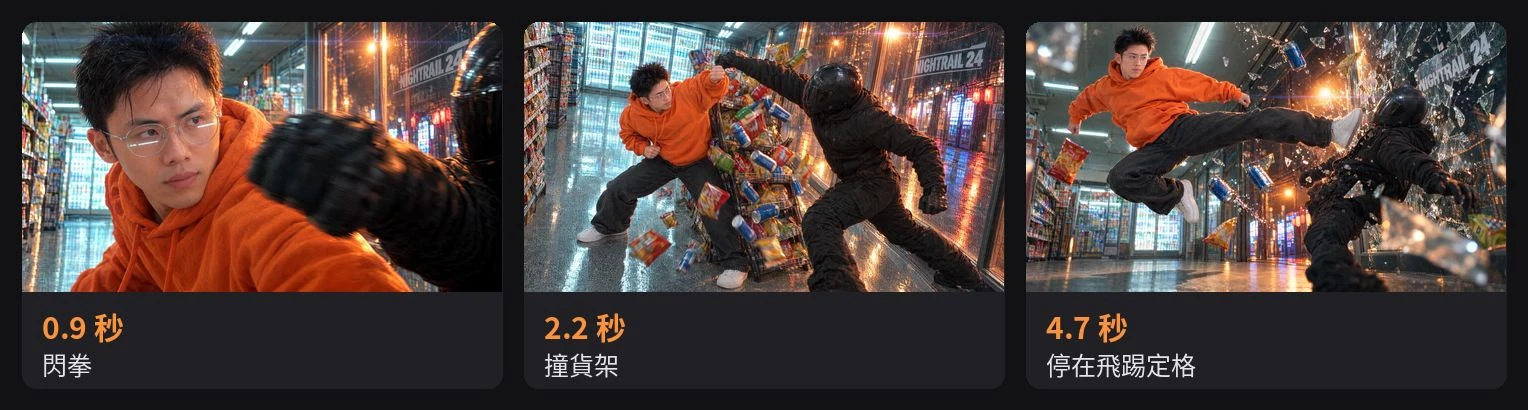
打鬥視頻的提示詞
FORMAT: a fast-cut, four-shot Hollywood action sequence, 5 seconds, 16:9, live-action, photorealistic, with hard cuts between shots. The first frame matches @Image 1 exactly. The last frame matches @Image 2 exactly in composition, pose, camera position, lighting and colour. Shots 2, 3 and 4 each match their storyboard reference image in framing, camera angle and pose. Hard-hitting, precise, readable fight choreography by a top stunt team: every strike is clean, fast and clearly visible. Real-time speed until the final speed ramp.

STORYBOARD MAPPING
- Shot 1 = @Image 1: medium-wide, the attacker throws a right hook and the hero slips under it.
- Shot 2 = @Image 3: extreme close-up of the hero's eyes and glasses, a gloved fist blurring past in the foreground.
- Shot 3 = @Image 4: high angle, the hero blocks a backhand and crashes into the snack display rack.
- Shot 4 = @Image 5, ending on @Image 2: low angle at hip height, the hero launches a jumping side kick that lands and freezes.
- @Image 6, @Image 7 and @Image 8 define the hero's face, glasses, hair, body and outfit.

SHOT 1 | 0.0–1.0 s | MEDIUM-WIDE, THE SLIP AND COUNTER
Camera: chest height, 28 mm, 5-degree Dutch tilt, starting exactly on @Image 1, then an aggressive, perfectly stabilised Steadicam push-in.
Action: the attacker's right hook whips over the hero's head as he slips under it, his drawstrings snapping sideways. He rises out of the slip and fires a lightning-fast left jab that snaps the helmet back, then a right cross into the visor. The attacker reels.
Sound: a tearing whoosh of the missed fist, a sneaker squeak on wet vinyl, two layered punch impacts with a leather snap on top and a deep bass thump underneath, the plastic crack of a fist on the helmet.
HARD CUT on the moment the attacker swings back at him.

SHOT 2 | 1.0–1.5 s | EXTREME CLOSE-UP, THE EYES
Camera: 85 mm, eye level, locked off, razor-thin focus on the eye nearest the lens, matching @Image 3.
Action: the attacker's black gloved fist streaks through the extreme foreground, a dark motion-blurred shape. The hero does not blink; his eyes track the attacker, sharp and calm, as a streak of fluorescent light slides across his glasses. A bead of sweat runs from his temple.
Sound: a close, tearing whoosh panning across the frame, one controlled exhale.
HARD CUT on the impact of the next blow.

SHOT 3 | 1.5–2.4 s | HIGH ANGLE, THE CRASH
Camera: high angle about 3 m above the floor, 28 mm, matching @Image 4, then a fast, smooth crane-down while tilting to follow the falling rack.
Action: the attacker's wide backhand crashes into the hero's raised forearm; the force spins him and his shoulder slams into the snack display rack. The metal rack tips over; dozens of colourful snack bags and blue soda cans explode off its shelves and fly through the air between the fighters, catching the orange backlight; one can bursts and sprays soda. The hero uses the spin to turn back toward the attacker.
Sound: a thick forearm block, a big metallic crash, bags rustling and crinkling, cans clanging, the fizz of a bursting can.
HARD CUT as the hero plants his foot to jump.

SHOT 4 | 2.4–5.0 s | LOW ANGLE, THE KICK AND THE FREEZE
Camera: hip height at the hero's front three-quarter, 35 mm anamorphic, matching @Image 5, locked in place with only a tiny push-in, ending exactly on @Image 2.
2.4–3.2 s: real-time speed. The hero is in the air, his body rotating toward horizontal; his chambered right knee drives forward and his right leg shoots out toward the attacker's chest. Hoodie hem and drawstrings flare outward, hair lifts. Snacks and cans from the rack are still flying around them. Sound: a fierce exhale, a rush of air, cloth flapping.
3.2–3.6 s: the sole of the white sneaker hits the attacker's chest with full force. The attacker folds backward into the front window; the glass bursts outward around his back in a starburst of cracks and shards, the "NIGHTRAIL 24" decal splitting apart. A pressure wave pushes the floating snacks outward. Sound: a colossal layered impact, a deep sub-bass boom, a body thud, a high glass crack.
3.6–5.0 s: a smooth, dramatic speed ramp from real time to extreme slow motion to an almost complete stop. Hundreds of glass shards, snack bags, soda cans and droplets slow down and hang in the air, each shard catching the orange light. The hero hangs horizontally in mid-air, kick on the attacker's chest. The final frame is identical to @Image 2. Sound: the shatter stretches and pitches down as time slows, then all sound is sucked out into near silence, leaving only a deep sub-bass hum and a faint crystalline shimmer.

CHARACTERS
- THE HERO: an East Asian man in his late twenties, the person in @Image 6, @Image 7 and @Image 8. Face, thin silver round metal-frame glasses, short spiky black hair and body proportions stay identical in every shot, from every angle, including the extreme close-up. Bright orange plain oversized pullover hoodie, hood down; deep charcoal-black washed wide-leg jeans with long stacked hems; white low-top sneakers. No text or logos on his clothing.
- THE ATTACKER: an adult man in a matte-black full-face motorcycle helmet with a dark smoked visor, plain black jacket, dark trousers, black gloves. His face is never visible.

SET: a small 24-hour Japanese neighbourhood convenience store at 3 a.m. Densely stocked shelves of colourful packaging from fictional brands with no readable text, a back wall of glass-door drink fridges glowing cyan-white, rows of fluorescent ceiling panels, a grey speckled vinyl floor with a wet sheen. A freestanding snack display rack stands between the fighters until Shot 3. The large front window carries a white "NIGHTRAIL 24" decal. Outside: a narrow wet side street at night, utility poles with tangled overhead wires, glowing vending machines, red paper izakaya lanterns, an orange sodium streetlight.

SCREEN DIRECTION (180-degree rule, every shot): the hero is on the left facing right; the attacker is on the right facing left; the front window is behind the attacker on the right.

LIGHTING (identical in every shot): the orange streetlight comes through the front window as a hard warm backlight, rim-lighting both fighters. Cool green-white fluorescent top light inside, cyan fridge glow as fill. Thin haze in the air so light beams are visible. Deep blacks, high-contrast teal-and-orange grade; the orange hoodie is the most saturated element in the frame.

LOOK: live-action Hollywood action blockbuster, shot on 35 mm film, fine grain, slight halation on highlights, anamorphic horizontal lens flares, shallow depth of field, razor-sharp detail on the hero's face, realistic physics for cloth, hair, water, glass and falling objects.

AUDIO: realistic, cinematic, layered sound effects and foley only. No music. No dialogue; breaths and grunts are allowed.

CONTINUITY
- The front window stays intact until the kick lands in Shot 4.
- The snacks and cans in the air in Shot 4 come from the rack knocked over in Shot 3.
- The window text reads only "NIGHTRAIL 24" whenever visible.

AVOID: music, merging the four shots into one, missing cuts, camera shake, motion-blur smearing of faces, crossing the 180-degree line, mismatched lighting between shots, slow motion before 3.6 s, blood, injury, weapons, the attacker's face, morphing or melting faces, extra limbs, distorted hands, warped text, real brand logos, the colour stripes of real Japanese convenience-store chains.
3. 子彈時間
第一版只有 5 秒,鏡頭幾乎沒繞,我還懸在半空。
「改成 8 秒,每一段都寫清楚:前半秒定格;0.5 到 4.5 秒,鏡頭繞著我轉;4.5 秒恢復速度,對手飛出,我落地,再起身。」
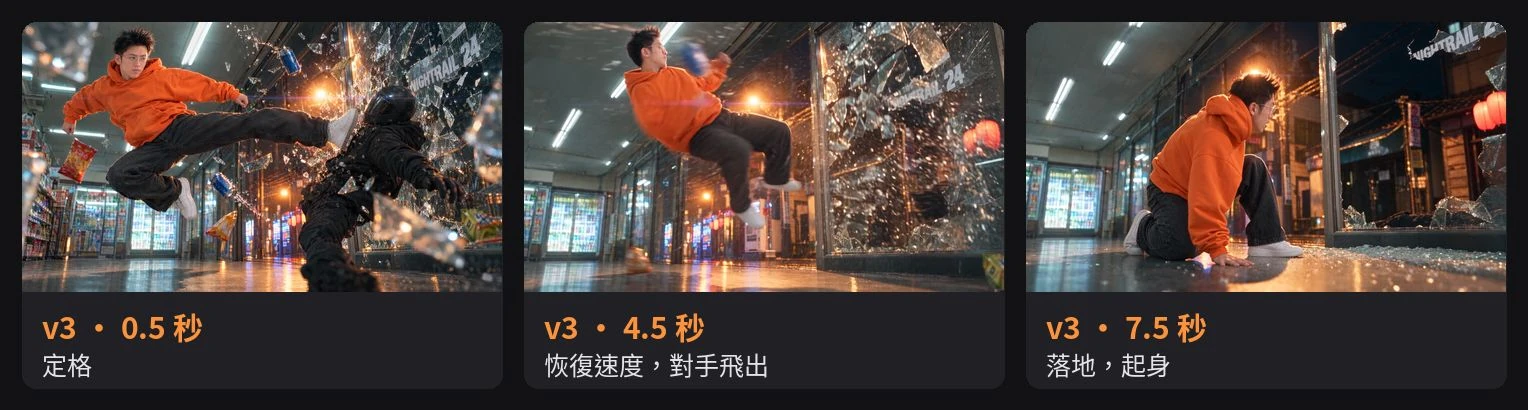
子彈時間的提示詞
FORMAT: one continuous cinematic shot, no cuts, 8 seconds, 16:9, live-action Hollywood action film, photorealistic. The first frame matches @Image 1 exactly in composition, pose, lighting and colour.

CHARACTERS
- THE HERO: an East Asian man in his late twenties, the person in @Image 2, @Image 3 and @Image 4. Face, thin silver round metal-frame glasses, short spiky black hair and body proportions stay identical to the references in every frame. Bright orange plain oversized pullover hoodie, deep charcoal-black washed wide-leg jeans with stacked hems, white low-top sneakers. No text or logos on his clothing.
- THE ATTACKER: an adult man in a matte-black full-face motorcycle helmet with a dark smoked visor, plain black jacket, dark trousers. His face is never visible.

SET: a small 24-hour Japanese neighbourhood convenience store at 3 a.m. Densely stocked shelves of colourful snack packaging, a back wall of glass-door drink fridges glowing cyan-white, rows of fluorescent ceiling panels, a grey speckled vinyl floor with a wet sheen. The large front window carries a white "NIGHTRAIL 24" decal. Outside: a narrow wet side street, utility poles with tangled overhead wires, glowing vending machines, red paper izakaya lanterns, an orange sodium streetlight.

LIGHTING: the orange streetlight floods in through the breaking window as a hard warm backlight, rim-lighting the hero's hair, shoulders, the hoodie edges and every glass shard. Cool green-white fluorescent top light inside, cyan fridge glow as fill. Thin haze in the air so light beams are visible. Deep blacks, high-contrast teal-and-orange grade; the orange hoodie is the most saturated element in frame.

SHOT TIMELINE

0.0–0.5 s | THE FREEZE
Camera: low, at the hero's hip height, about 2.5 m from him at his front three-quarter, 35 mm anamorphic lens, exactly as in @Image 1. Completely still for half a second.
Action: total freeze. The hero hangs horizontally in mid-air, right leg fully extended, sole of his white sneaker pressed into the attacker's chest, left leg tucked, fists in guard, hoodie hem and drawstrings flared out. The attacker is bent backward into the window. Hundreds of glass shards, snack bags and blue soda cans hang motionless around them; a frozen arc of soda droplets hangs in the air.

0.5–4.5 s | BULLET-TIME ORBIT
Camera: begins a smooth, slow, perfectly steady arc on a circular dolly path around the hero, keeping a constant 2.5 m distance and constant hip height, travelling about 100 degrees clockwise: from his front three-quarter, across the front of his body, toward the window side, ending at a low angle beside the window looking back into the store, so the store interior, shelves and glowing fridges become the background. The lens stays locked on the hero's face; focus never leaves his eyes. Constant speed, eases in at the start and eases out at the end. No shake, no zoom, no handheld wobble.
Action: the world is still frozen, but alive at a microscopic level: glass shards rotate a few degrees as the camera passes, catching and losing glints of light; soda droplets drift a few millimetres; the hoodie fabric ripples extremely slowly; individual strands of his hair move slowly. The hero's eyes stay locked on the attacker, expression calm and controlled. Parallax makes the depth obvious: foreground shards slide fast across the lens, the hero slides slower, the background slowest.
Light: as the camera moves around, the warm backlight sweeps across his face and hair, and lens flares from the streetlight and fluorescent tubes slide across the frame.
Sound: no music. A deep sub-bass drone, a slow heartbeat, faint crystal tinkling from hanging glass, a soft whoosh as foreground shards pass the lens.

4.5–5.0 s | TIME SNAPS BACK
Camera: stops dead at its end position and holds still.
Action: a visible shockwave of motion: everything returns to full real-time speed at once. The kick lands with full force; the attacker is launched backward through the window and out onto the wet street; the glass, snacks and cans blast outward away from the store in a violent spray.
Sound: a hard bass impact, a loud glass shatter, cans clattering on asphalt.

5.0–6.5 s | THE LANDING
Camera: holds still, then tilts down slightly to follow the hero.
Action: gravity takes the hero. He drops out of the air, rotates his body upright during the fall, and lands on the wet floor on both feet in a deep crouch, his right hand slapping the floor for balance, knees bent, hoodie settling, a small splash of water spraying from his landing. Small glass fragments bounce and skitter across the floor around him.
Sound: the thud of his landing, glass skittering on vinyl.

6.5–8.0 s | THE LOOK
Camera: slow push-in of about 30 cm toward his face, still low.
Action: he stays in the crouch for a beat, breathing hard, then rises halfway and lifts his head to look out through the broken window at the street. A fluorescent tube above him flickers twice. Outside, the shattered "NIGHTRAIL 24" decal hangs in pieces on the window frame; the attacker lies motionless on the street in the orange light.
Sound: his heavy breathing, a buzzing fluorescent tube, distant rain on the street.

LOOK: shot on 35 mm film, fine grain, slight halation on highlights, anamorphic horizontal flares, shallow depth of field around f/2, razor-sharp detail on the hero's face and the glass.

CONTINUITY RULES
- The hero's face, glasses, hairstyle and outfit stay consistent with the references in every frame, from every camera angle.
- After 4.5 s the hero must move: he falls, lands and rises. He never stays floating or frozen after time resumes.
- The window text reads only "NIGHTRAIL 24" and stays readable whenever visible.

AVOID: the hero floating or frozen after 4.5 s, camera shake, jump cuts, zoom, blood, injury, the attacker's face, morphing or melting faces, extra limbs, distorted hands, warped text, real brand logos, the colour stripes of real Japanese convenience-store chains.04|第二場:雪原巨獸
1. 換場:上一段的最後一格,當下一段的第一格
「用子彈時間的最後一格當開頭、我雙手撐在列車頂當結尾,設計一個絲滑的轉場。」
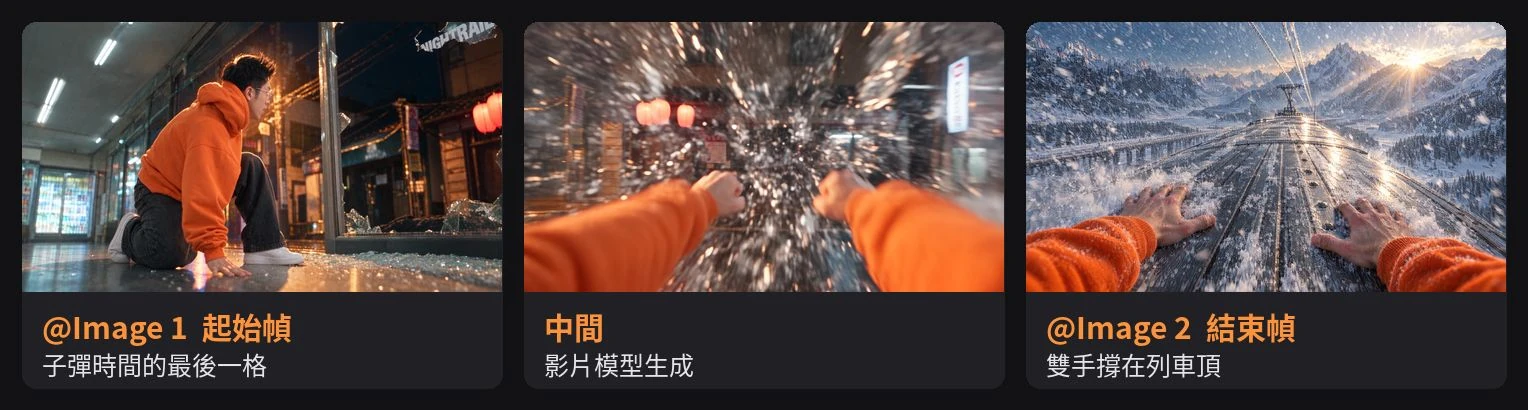
傳送門的提示詞
FORMAT: one continuous shot, no cuts, 5 seconds, 16:9, 24 fps, a top-tier Hollywood sci-fi action blockbuster. A high-momentum, character-driven portal transition: the man sprints out of a convenience store through a broken window, the camera chases him and pushes into his point of view, and as he dives through the window, space itself warps into a sci-fi tunnel of light that ruptures into a Siberian mountain wilderness at dawn, where he lands on the roof of a speeding train. The camera never stops moving forward. The first frame matches @Image 1 exactly. The last frame matches @Image 2 exactly in composition, camera position, lighting and colour.

THE MAN: the person in @Image 3, @Image 4 and @Image 5. Face, thin silver round metal-frame glasses, short spiky black hair and body proportions stay identical whenever he is seen. Bright orange plain oversized pullover hoodie with ribbed cuffs, deep charcoal-black washed wide-leg jeans, white low-top sneakers. No text or logos.

0.0–0.8 s | THE LAUNCH
Camera: starts exactly on @Image 1, low behind his left shoulder, then swings in behind him and accelerates like a heavy camera on a fast chase rig.
Action: he explodes up from his kneeling pose, pushing off the floor with his right hand, glass crunching under his sneakers, and sprints toward the broken front window.
Sound: glass crunching, pounding footsteps, a sharp intake of breath, his heartbeat rising.

0.8–1.6 s | INTO HIS EYES
Camera: pushes forward past the back of his head and merges into his first-person point of view at eye height, stabilised like a head-mounted gimbal with a natural running bob. His orange sleeves and fists pump at the bottom edges of the frame.
Action: the broken window rushes toward the camera with two fast strides; the jagged glass and the torn "NIGHTRAIL 24" decal grow in the frame as he dives at it.
Sound: loud close breathing, footsteps, the fluorescent hum.

1.6–2.8 s | THE BREACH
Camera: first person, plunging through the window frame.
Action: as he crosses the plane of the broken window, the fracture lines in the glass ignite with thin threads of cold white light. The space beyond the frame bends like liquid glass: the night street warps, refracts and stretches, and its streetlights, red lanterns and neon smear into thousands of streaks of light rushing past the camera, forming a tunnel of light. Strong real lens refraction and chromatic fringing ripple across the frame. Snowflakes appear inside the tunnel and streak toward the lens.
Sound: all sound is sucked into a sudden pressure vacuum, a deep rising sub-bass, a high glassy whine climbing in pitch.

2.8–3.8 s | THE RUPTURE
Camera: first person, bursting out of the tunnel.
Action: the tunnel ruptures outward like a membrane tearing open, and blinding golden dawn light and a roaring blizzard flood in. Below him, the frosted graphite roof of a futuristic high-speed train races up toward the camera across a vast Siberian mountain wilderness, the great snow peak far ahead, the low sun just above its right shoulder in the upper right of the frame.
Sound: a massive boom as the tunnel bursts, then the sudden thunderous roar of the high-speed train and the howl of the blizzard.

3.8–5.0 s | THE LANDING
Camera: first person. On impact the view drops sharply with the weight of the landing and recovers, looking down and forward along the roof, ending exactly on @Image 2.
Action: his two hands slap down onto the frosted steel roof, fingers spreading, a burst of powder snow exploding up around them. Snow flies toward the camera from ahead; the low golden sun grazes the backs of his hands.
Sound: a heavy thud on steel, the rapid clatter of the rails, his gasp.

LIGHT: the store's warm orange backlight and green-white fluorescent fill at the start; the tunnel of light in the middle; from 2.8 s the WORLD MAP lighting applies with the camera looking forward. The orange sleeves stay the most saturated element.

AVOID: a locked-off or static camera, a static background swap, a street outside the window after 1.6 s, cuts, music, cartoon morphing, nauseating shake, extra hands or fingers, distorted hands, morphing or melting faces, text or logos anywhere except the broken "NIGHTRAIL 24" decal, real train liveries, blood, injury.

WORLD MAP, FIXED FOR EVERY SHOT IN THE SNOW WORLD: the train always travels forward on a slender elevated track toward the largest snow peak in the far distance. The low dawn sun always sits just above the right shoulder of that great peak, ahead of the train and slightly to the right of the track; it never moves. The blizzard is a headwind: snow always blows from the front of the train toward the rear, and the man's hoodie and hair always stream backward toward the rear of the train. When the camera looks forward, the sun is in frame ahead and slightly right, and subjects are backlit with shadows falling toward the camera. When the camera looks backward, the sun is behind the camera and never in frame, and subjects are lit from the front. Inside the convenience store at the start of T1, this map does not apply yet.

REALISM AND MATERIALS: this must look like footage photographed on a real film set and finished by a top VFX house, never like a digital render or an AI video.
- Skin: real human skin with visible pores, fine peach fuzz, knuckle creases, natural unevenness, subsurface scattering on ears and fingers, cold-reddened cheeks and knuckles. No plastic, waxy or airbrushed skin.
- Fabric: the hoodie is heavy cotton fleece with visible knit texture, slight pilling, real seams and ribbed cuffs; it folds and flaps with real weight and catches snow in its fibres. The jeans are rigid washed denim with visible twill weave, real stitching. The sneakers show creases, scuffs and wet snow on the soles.
- Hard surfaces: metal shows scratches, grime, rivets, ice crust and oxidation; glass breaks and scatters with real weight; rock shows real strata, cracks, lichen and weathering; ice is translucent with trapped air bubbles and refraction; concrete shows weathering and frost; snow is crystalline, sparkles, compacts under weight and blows as fine spindrift.
- Physics: everything has believable mass, inertia, gravity and scale. Large objects fall and move slowly; small debris moves fast. Wind direction and strength are consistent for snow, hair and cloth. Contact points show real weight: feet compress snow, hands press into surfaces, landings absorb impact through the knees. Real atmospheric perspective over long distances.
- Motion: 24 fps with a 180-degree shutter, natural motion blur on fast movement only; the camera moves like a real heavy rig with weight and inertia, never weightless or floaty.
- Light: physically based light with real falloff, bounce light and colour temperature: warm sun, cold sky fill, blue arc light; light scatters through snow and haze; true deep blacks without crushed detail.
- Lens and film: a real cinema lens with subtle chromatic aberration at the edges, natural vignetting, real bokeh, physically accurate lens flare, organic film grain and gentle halation on highlights.
- AVOID: CGI sheen, video-game look, oversaturated colours, HDR glow, over-sharpening, smooth plastic surfaces, cartoon proportions, floating objects with no weight, physically impossible lighting.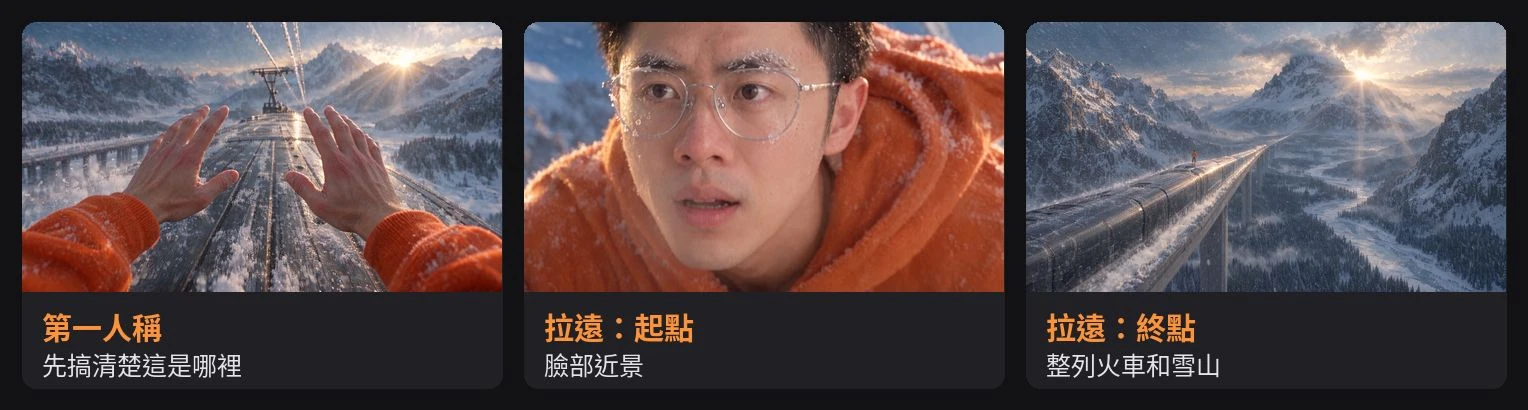
第一人稱的提示詞
FORMAT: one continuous first-person shot, no cuts, 4 seconds, 16:9, 24 fps, a top-tier Hollywood sci-fi action blockbuster. Through the man's eyes, just after landing on the roof of a speeding train: he looks at his own hands and around him in shock, disoriented by the sudden change of world, while the world rushes past at full speed. The first frame matches @Image 1 exactly.

POV CAMERA: at his eye height, stabilised like a head-mounted gimbal, with natural human head motion: quick, startled, reactive turns that snap and settle, never nauseating. Only his own two hands and orange sleeves are ever visible.

0.0–1.0 s | HIS HANDS
Action: he lifts both hands from the roof up in front of his face and turns them over, palms then backs, staring at them in disbelief. Snowflakes land on his fingers and melt; his breath steams across the frame and is torn backward by the headwind; his fingers tremble slightly.
Sound: the train's roar, the blizzard, his fast shaky breathing, a muffled heartbeat.

1.0–1.8 s | LEFT
Action: he whips his head to the left: the edge of the elevated track, and hundreds of metres below, a valley of dark pine forest and a frozen river streaking past at terrifying speed; jagged snowy mountains beyond. The low sun, now behind the right edge of his view, throws long shadows across the snow.
Sound: a gust roaring past, the rails hammering.

1.8–2.6 s | UP
Action: he snaps his head up: ice-coated high-voltage catenary wires race overhead, and a pantograph explodes in a burst of blue-white arc sparks right above him. He flinches.
Sound: a sharp, loud crack and sizzle of electric arcing.

2.6–4.0 s | AHEAD
Action: he swings his head back to look forward along the roof toward the front of the train. Far ahead, at the end of the track, the great snow peak rises into the clouds with the low golden sun blazing just above its right shoulder, piercing the blizzard in volumetric shafts that flare across the frame. He stares at it, breathing hard. The world never slows down.
Sound: the wind, the train, his breath catching, a single deep, distant rumble from the mountain.

LIGHT: the WORLD MAP applies. While looking forward, the sun is in frame ahead and slightly right; when he looks left, the sun leaves the frame to the right; when he looks up, warm light comes from the front.

AVOID: slow or lingering head turns, any slowing of the train or the world, a visible face, extra hands or fingers, distorted hands, nauseating shake, cuts, music, any city or buildings, text or logos anywhere, real train liveries, blood, injury.

WORLD MAP, FIXED FOR EVERY SHOT IN THE SNOW WORLD: the train always travels forward on a slender elevated track toward the largest snow peak in the far distance. The low dawn sun always sits just above the right shoulder of that great peak, ahead of the train and slightly to the right of the track; it never moves. The blizzard is a headwind: snow always blows from the front of the train toward the rear, and the man's hoodie and hair always stream backward toward the rear of the train. When the camera looks forward, the sun is in frame ahead and slightly right, and subjects are backlit with shadows falling toward the camera. When the camera looks backward, the sun is behind the camera and never in frame, and subjects are lit from the front. Inside the convenience store at the start of T1, this map does not apply yet.

REALISM AND MATERIALS: this must look like footage photographed on a real film set and finished by a top VFX house, never like a digital render or an AI video.
- Skin: real human skin with visible pores, fine peach fuzz, knuckle creases, natural unevenness, subsurface scattering on ears and fingers, cold-reddened cheeks and knuckles. No plastic, waxy or airbrushed skin.
- Fabric: the hoodie is heavy cotton fleece with visible knit texture, slight pilling, real seams and ribbed cuffs; it folds and flaps with real weight and catches snow in its fibres. The jeans are rigid washed denim with visible twill weave, real stitching. The sneakers show creases, scuffs and wet snow on the soles.
- Hard surfaces: metal shows scratches, grime, rivets, ice crust and oxidation; glass breaks and scatters with real weight; rock shows real strata, cracks, lichen and weathering; ice is translucent with trapped air bubbles and refraction; concrete shows weathering and frost; snow is crystalline, sparkles, compacts under weight and blows as fine spindrift.
- Physics: everything has believable mass, inertia, gravity and scale. Large objects fall and move slowly; small debris moves fast. Wind direction and strength are consistent for snow, hair and cloth. Contact points show real weight: feet compress snow, hands press into surfaces, landings absorb impact through the knees. Real atmospheric perspective over long distances.
- Motion: 24 fps with a 180-degree shutter, natural motion blur on fast movement only; the camera moves like a real heavy rig with weight and inertia, never weightless or floaty.
- Light: physically based light with real falloff, bounce light and colour temperature: warm sun, cold sky fill, blue arc light; light scatters through snow and haze; true deep blacks without crushed detail.
- Lens and film: a real cinema lens with subtle chromatic aberration at the edges, natural vignetting, real bokeh, physically accurate lens flare, organic film grain and gentle halation on highlights.
- AVOID: CGI sheen, video-game look, oversaturated colours, HDR glow, over-sharpening, smooth plastic surfaces, cartoon proportions, floating objects with no weight, physically impossible lighting.
拉遠的提示詞
FORMAT: one continuous shot, no cuts, 6 seconds, 16:9, 24 fps, a top-tier Hollywood sci-fi action blockbuster. A breathtaking pull-back reveal: the camera starts on a close-up of the man's stunned face on the roof of a speeding train and pulls back and up in one unbroken move, rising into the sky and arcing around to behind the train, until he is a tiny orange figure alone on a 400-metre train racing across a colossal Siberian mountain wilderness toward a great snow peak. The first frame matches @Image 1 exactly. The last frame matches @Image 2 exactly in composition, camera position, lighting and colour.

THE MAN: the person in @Image 3, @Image 4 and @Image 5. Face, thin silver round metal-frame glasses, short spiky black hair and body proportions stay identical. Bright orange plain oversized pullover hoodie, deep charcoal-black washed wide-leg jeans, white low-top sneakers. No text or logos.

0.0–1.2 s | THE FACE
Camera: starts exactly on @Image 1, a front close-up at eye level, the camera in front of him looking back toward the rear of the train. Then begins to pull back smoothly and fast.
Action: he is stunned, eyes wide, breathing hard, snow on his glasses, his hoodie and hair streaming backward. As the camera retreats, he slowly rises from his crouch to his full height, unsteady, arms slightly out for balance against the headwind.
Sound: his breathing close to the mic, the roar of the train, the howl of the wind.

1.2–3.5 s | THE RISE
Camera: keeps pulling back and starts to rise steeply like a helicopter lifting off, while beginning a wide arc around the left side of the train.
Action: more and more of the train is revealed: the long frosted graphite roof, the ice-coated catenary wires, a pantograph throwing blue-white sparks, snow exploding off the sides, the slender elevated concrete track on its tall piers, the valley of pine forest and the frozen river far below. He becomes smaller and smaller, a single orange figure standing on the roof.
Sound: the train's roar fading under a rising wind, the sound of the vast valley opening up.

3.5–6.0 s | THE REVEAL
Camera: completes the arc to a high aerial position behind and to the left of the train, about 300 metres above the track, now looking forward along the train's path, and settles, ending exactly on @Image 2.
Action: the full scale is revealed: the 400-metre train racing on its curving elevated track through a colossal empty wilderness of jagged snow-covered mountains, the tiny orange figure on its roof, and straight ahead, at the end of the track, the immense great peak with a long ridge like a sleeping creature's back, its summit lost in cloud.
Sound: a deep, ominous low drone from the mountains, the distant roar of the train, the wind.

LIGHT, FOLLOWING THE WORLD MAP AS THE CAMERA TURNS: at the start, the camera looks backward, so the sun is behind the camera and lights his face from the front-left. As the camera arcs around the left side, the sun swings into the frame from the right, and by the end, looking forward, the low golden sun sits just above the great peak's right shoulder, its god rays streaming across the valley toward the camera, with all shadows stretching toward the camera. The orange figure is the most saturated element in every frame.

AVOID: the sun in frame during the first second, a jumpy or reversing camera path, cuts, music, a miniature or tilt-shift look, a visible monster or creature, any city or buildings, morphing or melting faces, extra limbs, text or logos anywhere, real train liveries, blood, injury.

WORLD MAP, FIXED FOR EVERY SHOT IN THE SNOW WORLD: the train always travels forward on a slender elevated track toward the largest snow peak in the far distance. The low dawn sun always sits just above the right shoulder of that great peak, ahead of the train and slightly to the right of the track; it never moves. The blizzard is a headwind: snow always blows from the front of the train toward the rear, and the man's hoodie and hair always stream backward toward the rear of the train. When the camera looks forward, the sun is in frame ahead and slightly right, and subjects are backlit with shadows falling toward the camera. When the camera looks backward, the sun is behind the camera and never in frame, and subjects are lit from the front. Inside the convenience store at the start of T1, this map does not apply yet.

REALISM AND MATERIALS: this must look like footage photographed on a real film set and finished by a top VFX house, never like a digital render or an AI video.
- Skin: real human skin with visible pores, fine peach fuzz, knuckle creases, natural unevenness, subsurface scattering on ears and fingers, cold-reddened cheeks and knuckles. No plastic, waxy or airbrushed skin.
- Fabric: the hoodie is heavy cotton fleece with visible knit texture, slight pilling, real seams and ribbed cuffs; it folds and flaps with real weight and catches snow in its fibres. The jeans are rigid washed denim with visible twill weave, real stitching. The sneakers show creases, scuffs and wet snow on the soles.
- Hard surfaces: metal shows scratches, grime, rivets, ice crust and oxidation; glass breaks and scatters with real weight; rock shows real strata, cracks, lichen and weathering; ice is translucent with trapped air bubbles and refraction; concrete shows weathering and frost; snow is crystalline, sparkles, compacts under weight and blows as fine spindrift.
- Physics: everything has believable mass, inertia, gravity and scale. Large objects fall and move slowly; small debris moves fast. Wind direction and strength are consistent for snow, hair and cloth. Contact points show real weight: feet compress snow, hands press into surfaces, landings absorb impact through the knees. Real atmospheric perspective over long distances.
- Motion: 24 fps with a 180-degree shutter, natural motion blur on fast movement only; the camera moves like a real heavy rig with weight and inertia, never weightless or floaty.
- Light: physically based light with real falloff, bounce light and colour temperature: warm sun, cold sky fill, blue arc light; light scatters through snow and haze; true deep blacks without crushed detail.
- Lens and film: a real cinema lens with subtle chromatic aberration at the edges, natural vignetting, real bokeh, physically accurate lens flare, organic film grain and gentle halation on highlights.
- AVOID: CGI sheen, video-game look, oversaturated colours, HDR glow, over-sharpening, smooth plastic surfaces, cartoon proportions, floating objects with no weight, physically impossible lighting.
2. 世界設定:固定方向和光線
一開始每張圖各寫各的,太陽位置都不一樣。
「先寫一份世界設定,每張圖都帶上:列車往哪開、太陽在哪、風往哪吹、鏡頭朝哪個方向。」
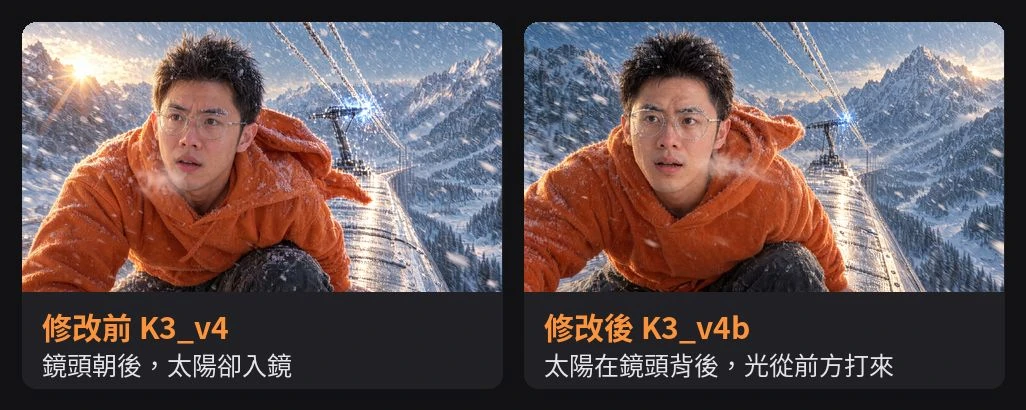
加了世界設定的提示詞(看最後 WORLD MAP 那一段)
Cinematic 16:9 film still from a top-tier Hollywood sci-fi action blockbuster. A front-facing close-up of a man crouching on the roof of a futuristic high-speed train racing across a vast, empty Siberian mountain wilderness at dawn, in a blizzard, a split second after he has suddenly found himself there.

IDENTITY: the man is the person in @Image 5, @Image 2, @Image 3 and @Image 4. Keep his face, thin silver round metal-frame glasses, short spiky black hair and proportions identical to the references. This is the most important part of the image.

THE MAN: medium close-up from the front, from mid-chest up, slightly off-centre to the left, facing the camera and facing the front of the train, his eyes looking just past the left side of the lens. He crouches low on the roof, bracing against the headwind, one hand on the roof below the frame. Expression: stunned and disoriented, eyes wide, brows raised and pulled together, lips slightly parted, breathing hard; white breath vapour streams backward past his cheek. Snowflakes cling to his spiky black hair, his eyebrows and the lenses and frame of his glasses; a few melting drops on the lenses. His cheeks and the tip of his nose are reddened by the cold. Bright orange plain oversized pullover hoodie, hood down, streaming backward hard in the wind, snow caught in the fleece. No text or logos on his clothing.

CAMERA DIRECTION AND LIGHT FOR THIS SHOT: the camera is in front of him, looking backward toward the rear of the train. The sun is behind the camera, slightly to the left, and is not visible anywhere in the frame. Warm, low golden sunlight falls directly on his face and chest from the front-left, catching the snow on his glasses and sculpting his face with soft golden highlights; his shadow falls behind him onto the roof toward the rear of the train. The background is the sunlit rear of the train and the mountains behind it under a cold blue sky: no sun disc, no sunrise glow, no sun flare in the frame. Snow flies past him from behind the camera toward the background. A pantograph far behind him throws small blue-white arc sparks.

BEHIND HIM: the long frosted graphite roof of the train recedes toward the rear, ice-coated catenary wires running overhead, jagged snow-covered Siberian mountains and a valley of dark pine forest far below on both sides, streaking with speed. Not a single building, road or city light anywhere.

CAMERA: eye level, 50 mm anamorphic lens, f/2, razor-sharp focus on his eyes, background soft with natural motion blur from the train's speed.

AVOID: the sun or a sunrise anywhere in the frame, backlighting on his face, snow blowing toward the camera, any city or buildings, text or logos anywhere, real train liveries, an angry or heroic expression, blood, injury, sunglasses, extra people, distorted hands, watermark.

WORLD MAP, FIXED FOR EVERY SHOT OF THIS SEQUENCE: the train always travels forward on a slender elevated track toward the largest snow peak in the far distance. The low dawn sun always sits just above the right shoulder of that great peak, ahead of the train and slightly to the right of the track; it never moves. The blizzard is a headwind: snow always blows from the front of the train toward the rear, and the man's hoodie and hair always stream backward toward the rear of the train. When the camera looks forward, the sun is in frame ahead and slightly right, and subjects are backlit with shadows falling toward the camera. When the camera looks backward, the sun is behind the camera and never in frame, and subjects are lit from the front.

REALISM AND MATERIALS: this must look like a frame photographed on a real film set and finished by a top VFX house, never like a digital render or an AI image.
- Skin: real human skin with visible pores, fine peach fuzz, knuckle creases, natural unevenness, subsurface scattering on ears and fingers, cold-reddened cheeks and knuckles. No plastic, waxy or airbrushed skin.
- Fabric: the hoodie is heavy cotton fleece with visible knit texture, slight pilling, real seams and ribbed cuffs; it folds with real weight and catches snow in its fibres. The jeans are rigid washed denim with visible twill weave, fading on the knees, real stitching. The sneakers show creases, scuffs and wet snow on the soles.
- Hard surfaces: metal shows scratches, grime, rivets, ice crust and oxidation; rock shows real strata, cracks, lichen and weathering; ice is translucent with trapped air bubbles and refraction; concrete shows weathering and frost; snow is crystalline, sparkles, compacts under weight and blows as fine spindrift.
- Physics: everything has believable mass, inertia, gravity and scale. Large objects fall and move slowly; small debris moves fast. Wind direction and strength are consistent for snow, hair and cloth. Contact points show real weight: feet compress snow, hands press into surfaces. Real atmospheric perspective over long distances.
- Light: physically based light with real falloff, bounce light and colour temperature: warm sun, cold sky fill, blue arc light; light scatters through snow and haze; true deep blacks without crushed detail.
- Lens and film: a real cinema lens with subtle chromatic aberration at the edges, natural vignetting, real bokeh, physically accurate lens flare, organic film grain and gentle halation on highlights.
- AVOID: CGI sheen, video-game look, oversaturated colours, HDR glow, over-sharpening, smooth plastic surfaces, cartoon proportions, floating objects with no weight, physically impossible lighting.
3. 巨獸:先定起點和終點,再生成中間
每一段都先做起點、終點兩張圖,再讓視頻模型補中間的動作。
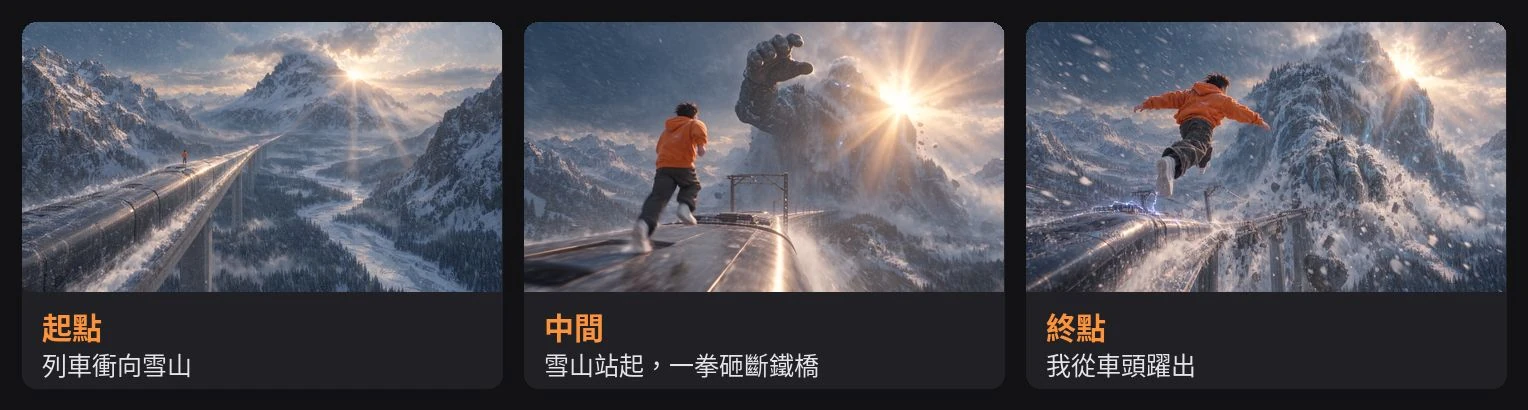
砸橋跳車的提示詞
FORMAT: one continuous shot, no cuts, 8 seconds, 16:9, 24 fps, a top-tier Hollywood sci-fi action blockbuster. The camera looks forward for the whole shot. From a high aerial view, the audience sees the great snow peak ahead begin to move; the camera dives down to the train and races in behind the man as he sprints along the roof; the mountain rises into a colossal titan, smashes the track ahead, and the man leaps off the front of the train. The first frame matches @Image 1 exactly. The last frame matches @Image 2 exactly in composition, pose, camera position, lighting and colour. Real-time speed throughout.

THE MAN: the person in @Image 3, @Image 4 and @Image 5. Face, thin silver round metal-frame glasses, short spiky black hair and body proportions stay identical. Bright orange plain oversized pullover hoodie, deep charcoal-black washed wide-leg jeans, white low-top sneakers. No text or logos.

0.0–1.5 s | THE MOUNTAIN MOVES
Camera: starts exactly on @Image 1, a high aerial view behind and to the left of the train, drifting forward.
Action: far ahead, the great peak shudders. A crack runs along its long ridge; a slow, enormous avalanche begins to pour down its flanks. A colossal low boom rolls across the valley and shakes snow off every pine tree in a wave. The tiny orange figure on the train turns to look.
Sound: a single earth-shaking sub-bass boom, the grinding crack of rock, the distant roar of the train.

1.5–3.0 s | THE DIVE
Camera: dives steeply down from the sky toward the train like a helicopter swooping, then levels out low behind the man, just above the roof, and races along with the train at his back, with the weight and inertia of a real heavy camera rig.
Action: he breaks into a sprint toward the front of the train, his sneakers biting into the frost and kicking up snow, his hoodie and hair streaming backward in the headwind. He leaps the gap between two carriages and lands with real weight.
Sound: the wind roar rushing past the lens, his footsteps pounding on steel, his breathing, the rail clatter.

3.0–5.0 s | THE RISE
Camera: tracking low behind him at shoulder height.
Action: ahead, the mountain stands up. What looked like a ridge is a colossal titan of layered granite strata and glacial ice plates with a pine forest on its back, rising to its full height above the clouds. House-sized boulders and rivers of snow fall from its body slowly, relative to its size. As it rises, its right shoulder moves directly in front of the low sun and eclipses it: golden god rays burst around its silhouette through the blizzard toward the camera. Two narrow glacial-blue eyes open high in the storm. He keeps running toward it, ducking under a burst of arc sparks from a pantograph.
Sound: a vast groaning roar of stone and ice, the crash of falling rock, the electric arc crackling, his breathing.

5.0–6.5 s | THE HAND
Camera: keeps tracking behind him, dropping slightly lower and pulling a little wider to show the full scale.
Action: the colossus slowly raises its enormous right hand, taking a full second, then brings it down onto the elevated track ahead of the train. The bridge breaks apart in a chain reaction: concrete piers buckle and collapse into the gorge one after another, track sections twist and fall, catenary towers snap and their wires whip through the air in showers of sparks. A shockwave of snow and debris rolls toward the camera.
Sound: an earth-shattering impact, a chain of concrete collapsing, steel shrieking, power lines snapping with electrical cracks.

6.5–8.0 s | THE LEAP
Camera: drops low behind him and rises slightly as he jumps, ending exactly on @Image 2.
Action: he reaches the very front of the train and, without slowing, launches himself off the nose into the open air toward the broken track and the colossus, body stretched forward, arms spread, the hoodie streaming back toward the camera. He is a backlit figure rimmed in gold against the eclipsed sun.
Sound: one powerful exhale, the wind swallowing everything, then a sudden near-silence with only the high whistle of wind.

LIGHT: the WORLD MAP applies, camera looking forward the whole time. The sun stays just above the great peak's right shoulder; once the titan rises, its right shoulder eclipses the sun and the god rays burst around it. The man is always backlit, his shadows falling toward the camera. The orange hoodie is the most saturated element in every frame.

AVOID: the sun moving to another position, light falling on the man's back, cuts, music, the colossus moving fast like a small animal, a dragon, Godzilla, King Kong or any recognisable film creature, any city or buildings, morphing or melting faces, extra limbs, distorted hands, text or logos anywhere, real train liveries, blood, injury.

WORLD MAP, FIXED FOR EVERY SHOT IN THE SNOW WORLD: the train always travels forward on a slender elevated track toward the largest snow peak in the far distance. The low dawn sun always sits just above the right shoulder of that great peak, ahead of the train and slightly to the right of the track; it never moves. The blizzard is a headwind: snow always blows from the front of the train toward the rear, and the man's hoodie and hair always stream backward toward the rear of the train. When the camera looks forward, the sun is in frame ahead and slightly right, and subjects are backlit with shadows falling toward the camera. When the camera looks backward, the sun is behind the camera and never in frame, and subjects are lit from the front. Inside the convenience store at the start of T1, this map does not apply yet.

REALISM AND MATERIALS: this must look like footage photographed on a real film set and finished by a top VFX house, never like a digital render or an AI video.
- Skin: real human skin with visible pores, fine peach fuzz, knuckle creases, natural unevenness, subsurface scattering on ears and fingers, cold-reddened cheeks and knuckles. No plastic, waxy or airbrushed skin.
- Fabric: the hoodie is heavy cotton fleece with visible knit texture, slight pilling, real seams and ribbed cuffs; it folds and flaps with real weight and catches snow in its fibres. The jeans are rigid washed denim with visible twill weave, real stitching. The sneakers show creases, scuffs and wet snow on the soles.
- Hard surfaces: metal shows scratches, grime, rivets, ice crust and oxidation; glass breaks and scatters with real weight; rock shows real strata, cracks, lichen and weathering; ice is translucent with trapped air bubbles and refraction; concrete shows weathering and frost; snow is crystalline, sparkles, compacts under weight and blows as fine spindrift.
- Physics: everything has believable mass, inertia, gravity and scale. Large objects fall and move slowly; small debris moves fast. Wind direction and strength are consistent for snow, hair and cloth. Contact points show real weight: feet compress snow, hands press into surfaces, landings absorb impact through the knees. Real atmospheric perspective over long distances.
- Motion: 24 fps with a 180-degree shutter, natural motion blur on fast movement only; the camera moves like a real heavy rig with weight and inertia, never weightless or floaty.
- Light: physically based light with real falloff, bounce light and colour temperature: warm sun, cold sky fill, blue arc light; light scatters through snow and haze; true deep blacks without crushed detail.
- Lens and film: a real cinema lens with subtle chromatic aberration at the edges, natural vignetting, real bokeh, physically accurate lens flare, organic film grain and gentle halation on highlights.
- AVOID: CGI sheen, video-game look, oversaturated colours, HDR glow, over-sharpening, smooth plastic surfaces, cartoon proportions, floating objects with no weight, physically impossible lighting.「巨獸就是正前方那座雪山。手要從正前方、從它自己的身體伸出來,鏡頭全程留在我身後。」
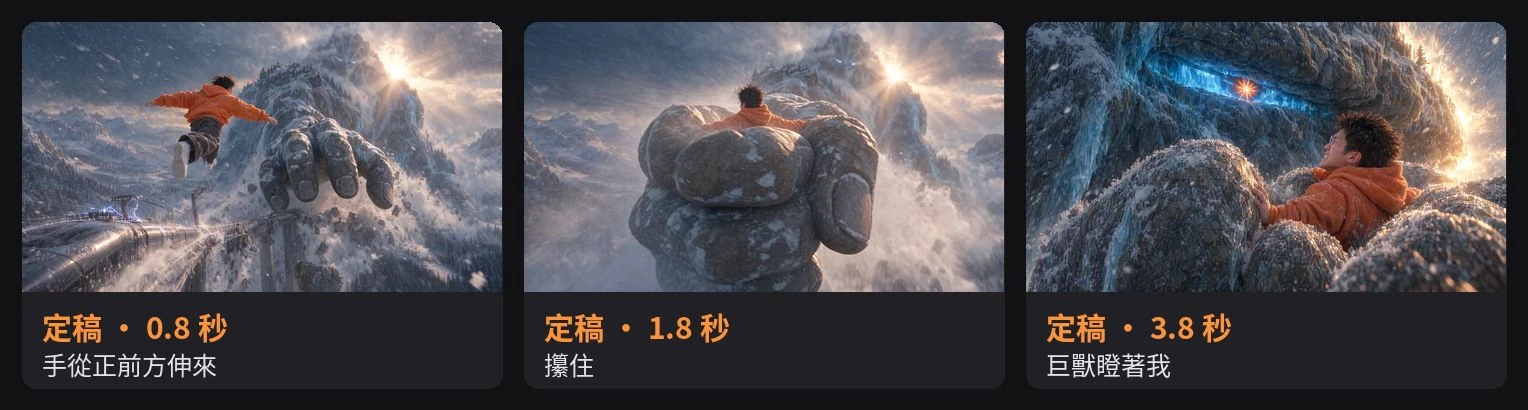
抓人的提示詞
One continuous 4-second shot, no cuts, a violent, fast-paced moment in a Hollywood action blockbuster, photoreal. Every movement is fast and brutal, and each action follows the previous one immediately, with no pauses and no slow motion. The same man throughout: the person in @Image 4, spiky black hair, thin round metal glasses, dry bright-orange hoodie with both sleeves intact.

WHERE EVERYTHING IS: the colossus is the great snow peak directly ahead, at the end of the track, exactly where it stands in @Image 1: its body is the mountain itself, facing the train, with the sun just above its right shoulder on the right of the frame. One of its fists still pins the broken bridge in front of the train. The colossus never moves sideways and never appears beside him: it only leans its upper body forward over the gorge, toward him. The camera stays behind him the whole time, looking forward at the colossus, and never circles around him.

0.0–0.7 s: continuing from @Image 1, he is in mid-air off the front of the train, the colossus straight ahead. The colossus leans forward, and its other hand, not the one pinning the bridge, comes straight out of its own body directly ahead of him and lunges toward him and toward the camera, its huge stone fingers spread wide, growing larger and larger.
0.7–1.2 s: the fingers slam shut around him in mid-air with a burst of snow and shattered ice. He is trapped in the fist up to his chest, only his upper body and arms sticking out between two stone fingers.
1.2–2.6 s: the fist pulls him straight back toward the colossus's own face, high on the mountain, in one fast, violent arc. The camera rides close behind him. He struggles hard the whole time, both palms shoving against the stone fingers, teeth gritted.
2.6–4.0 s: the fist slams to a halt right in front of one of its eyes. The glacial-blue eye narrows into a hostile glare and the orange starburst deep inside it flares brighter, staring at him, as in @Image 2. He keeps straining against the fingers. End exactly on @Image 2.

WORLD RULES: the low golden sun stays just above the colossus's right shoulder, on the right of the frame, with golden rays around its silhouette; the colossus and its fist are in cold blue shadow. A headwind blows snow from the colossus toward the camera. The colossus moves with enormous weight: its hand is fast at its scale, and snow, ice and rock shake loose from it. He stays dry; both sleeves stay intact. The orange starburst stays small, inside the eye, like a pupil.

SOUND: no music. A rushing roar as the hand lunges in; a deafening crack of stone and ice as the fingers slam shut; his pained grunt; grinding rock and wind as the fist pulls him back; a heavy thud as it halts; then a deep, menacing growl from the colossus and his hard breathing.

AVOID: a hand entering from the side of the frame, a second giant, the colossus standing beside him, the colossus moving away from the end of the track, the camera circling around him, pauses, slow motion, an open palm, him kneeling or standing on the hand, the hand flipping or turning over, the hand that pins the bridge moving, a large or flat orange logo, the sun on the left of the frame, blood, injury, crushed limbs, a wet hoodie, a torn sleeve, face changes, extra limbs, distorted hands, text, watermark, music.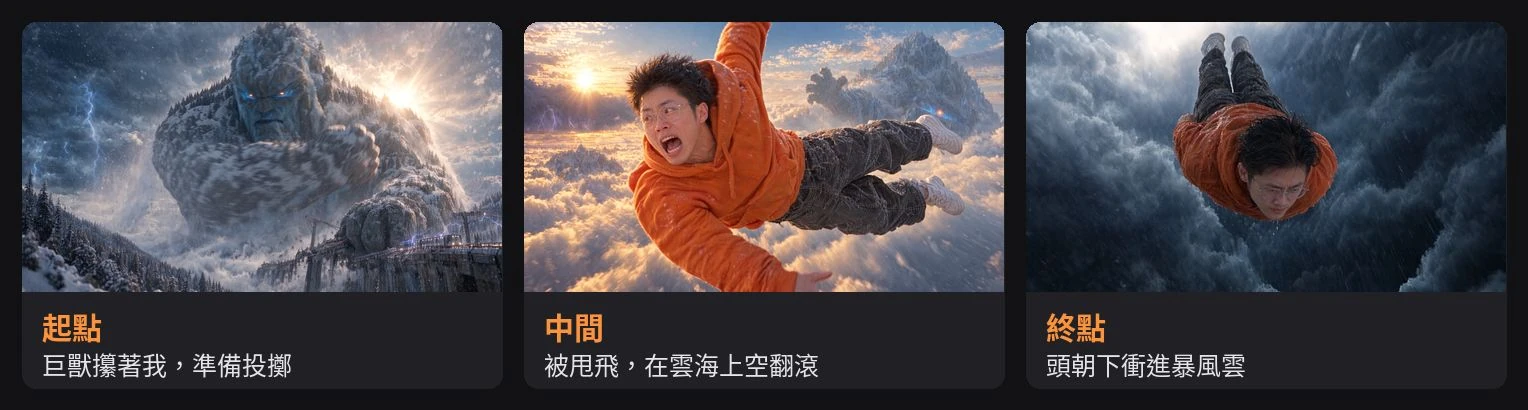
投擲的提示詞
A 6-second action sequence, two shots with one hard cut, Hollywood action blockbuster, photoreal. Every movement is fast and powerful, and each action follows the previous one immediately, with no pauses and no slow motion. The same man throughout: the person in @Image 4, spiky black hair, thin round metal glasses, bright-orange hoodie with both sleeves intact, deep charcoal-black wide-leg jeans, white sneakers.

SHOT 1, 0.0–2.2 s, the wide shot of @Image 1, the camera far back in the valley looking at the colossus: the colossus stays where it stands, at the end of the valley, facing the camera; its left fist, on the right of the frame, stays pinning the broken bridge. Its right arm, on the left of the frame, holds the tiny orange figure in its fist and throws him away behind it. First the arm drops down and swings forward across the front of its chest to gather force, its torso twisting; then it sweeps up and back in one huge arc over its own right shoulder, on the left of the frame. At the top of the arc, the fist opens and the tiny orange figure is hurled up and away behind the colossus, toward the dark storm wall on the left of the frame. Avalanches of snow and rock pour off the moving arm, and a blast of snow bursts outward from the swing. The camera shakes from the force.
HARD CUT at 2.2 s, exactly at the moment of release.
SHOT 2, 2.2–6.0 s, close, one continuous move:
- 2.2–3.9 s: he tumbles out of control high above the golden sea of clouds, spinning, arms and legs flailing, screaming with his mouth wide open, as in @Image 3. The camera flies alongside him on his left; he travels toward the left of the frame. Ahead on the left, the golden sun and the dark storm wall with lightning; behind him on the right, the colossus far away in the haze, its arm still raised after the throw.
- 3.9–4.9 s: he fights the spin, spreads his arms, stops tumbling and tips over into a head-first dive toward the storm wall, teeth gritted. The camera dives with him.
- 4.9–6.0 s: he plunges head-first into the storm cloud. The golden light vanishes in an instant; everything turns dark grey-blue; sleet and rain soak his hoodie at once; a lightning flash below lights his face from below. The camera ends in front of and below him, looking up at him. End exactly on @Image 2.

WORLD RULES: the colossus never walks, never turns around and never leaves its place at the end of the valley. It throws him backward over its shoulder, away from the train, never toward the camera. After the throw he always travels away from the colossus, toward the storm, and never turns back. The colossus moves with enormous weight and inertia: its arm is fast at its scale but heavy, trailing snow and rock. Above the clouds the low golden sun lights him in gold; inside the storm cloud there is no sun, only lightning. His hair and hoodie always whip in the wind. He is dry until he enters the storm cloud, then completely soaked. Both sleeves stay intact.

SOUND: no music. The deep grinding of rock and a rising roar as the arm swings; a massive whoosh and a blast of wind at the release; his scream, raw and loud, through the roaring wind while he tumbles; the wind changing pitch as he steadies into the dive; a deafening thunder crack and the hiss of heavy rain as he plunges into the cloud.

AVOID: the colossus throwing him toward the camera or toward the train, the colossus walking, turning around or moving away from the end of the valley, the fist on the bridge moving, the hand just opening without a throwing swing, a calm or neutral expression, smiling, gliding calmly, superhero flying pose, wings, a cape, a glowing aura, him flying back toward the colossus, the sun after he enters the cloud, a torn sleeve, face changes, extra limbs, distorted hands, text, watermark, music.投擲 v2 的提示詞(加了情緒順序)
A 6-second action sequence, two shots with one hard cut, Hollywood action blockbuster, photoreal. Every movement is fast and powerful, and each action follows the previous one immediately, with no pauses and no slow motion. The same man throughout: the person in @Image 4, spiky black hair, thin round metal glasses, bright-orange hoodie with both sleeves intact, deep charcoal-black wide-leg jeans, white sneakers. He is an ordinary man trapped inside an action film: the film makes his body move like a hero, but he himself is terrified and never feels calm or in control.

SHOT 1, 0.0–2.2 s, the wide shot of @Image 1, the camera far back in the valley looking at the colossus: the colossus stays where it stands, at the end of the valley, facing the camera; its left fist, on the right of the frame, stays pinning the broken bridge. Its right arm, on the left of the frame, holds the tiny orange figure in its fist and throws him away behind it. First the arm drops down and swings forward across the front of its chest to gather force, its torso twisting; then it sweeps up and back in one huge arc over its own right shoulder, on the left of the frame. At the top of the arc, the fist opens and the tiny orange figure is hurled up and away behind the colossus, toward the dark storm wall on the left of the frame. Avalanches of snow and rock pour off the moving arm, and a blast of snow bursts outward from the swing. The camera shakes from the force.
HARD CUT at 2.2 s, exactly at the moment of release.
SHOT 2, 2.2–6.0 s, close, one continuous move:
- 2.2–3.6 s: he tumbles out of control high above the golden sea of clouds, spinning, arms and legs flailing, screaming with his mouth wide open in terror, as in @Image 3. The camera flies alongside him on his left; he travels toward the left of the frame. Ahead on the left, the golden sun and the dark storm wall; behind him on the right, the colossus far away in the haze, its arm still raised after the throw.
- 3.6–4.2 s: still tumbling and screaming, he plunges into the top of the storm cloud. The golden light vanishes; everything turns dark grey-blue; sleet and rain soak his hoodie at once. The camera falls with him.
- 4.2–4.6 s: a lightning flash, and in that instant his body snaps rigid all by itself into a perfect head-first dive, arms swept back along his sides, as if yanked into place by invisible strings. He is not doing it; his body moves on its own. His scream stops.
- 4.6–5.4 s: diving perfectly, he stares down at his own arms in stunned disbelief: eyes wide, eyebrows raised, mouth half open, unable to believe his body is moving by itself.
- 5.4–6.0 s: he dives head-first down through the storm cloud, rain streaming over his face and glasses; he squints hard against the rain, tense and still shaken. A lightning flash below lights his face from below. The camera ends in front of and below him, looking up at him. End exactly on @Image 2.

EMOTION, in this order and never backward: terror while tumbling and entering the cloud; stunned disbelief when his body snaps into the dive on its own; then tense, shaken squinting against the rain. He is never calm, confident, proud or heroic.

WORLD RULES: the colossus never walks, never turns around and never leaves its place at the end of the valley. It throws him backward over its shoulder, away from the train, never toward the camera. After the throw he always travels away from the colossus, toward the storm, and never turns back. The colossus moves with enormous weight and inertia: its arm is fast at its scale but heavy, trailing snow and rock. Above the clouds the low golden sun lights him in gold; inside the storm cloud there is no sun, only lightning. His hair and hoodie always whip in the wind. He is dry until he enters the storm cloud, then completely soaked. Both sleeves stay intact.

SOUND: no music. The deep grinding of rock and a rising roar as the arm swings; a massive whoosh and a blast of wind at the release; his scream, raw and loud, through the roaring wind while he tumbles; the hiss of heavy rain as he enters the cloud; at 4.2 s a thunder crack and a sharp snap as his body locks into the dive, and his scream cut off into a stunned gasp; then the steady roar of the wind as he dives.

AVOID: a calm, confident, proud, determined or heroic expression, a smile, a superpower awakening, a glowing aura, electric arcs on his body, him choosing to dive, the colossus throwing him toward the camera or toward the train, the colossus walking, turning around or moving away from the end of the valley, the fist on the bridge moving, the hand just opening without a throwing swing, wings, a cape, him flying back toward the colossus, the sun after he enters the cloud, a torn sleeve, face changes, extra limbs, distorted hands, text, watermark, music.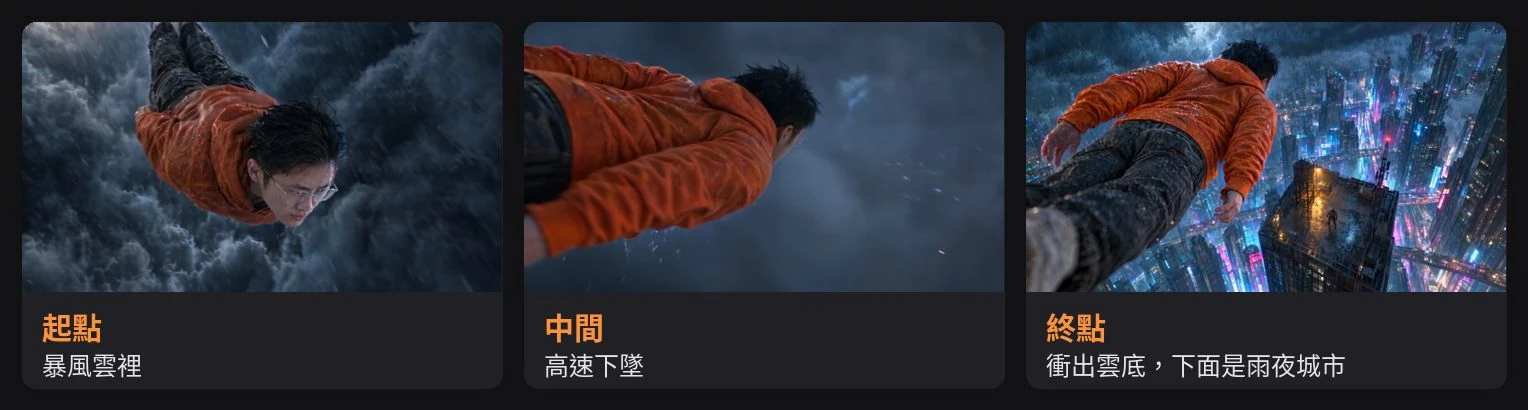
穿雲俯衝的提示詞
One continuous 5-second shot, no cuts, a high-speed freefall in a Hollywood action blockbuster, photoreal. The same man in every frame: the person in @Image 3, spiky black hair, thin round metal glasses, soaked dark-orange hoodie with both sleeves intact, soaked charcoal-black wide-leg jeans, white sneakers.

He is already falling at full terminal speed from the very first frame; nothing is slow.
0.0–2.5 s: inside the dark storm cloud. Torn masses of grey-blue vapour rip past him and past the lens every fraction of a second. Rain streaks are long, hard lines rushing upward past him. His hoodie flaps violently and the wind tears water off the fabric as spray; his hair whips; his cheeks ripple from the wind pressure; he squints. Two lightning flashes only, at 0.8 s and 1.9 s; between them the cloud stays visible as rushing grey texture, never black. The camera is locked close to him and shakes hard with the turbulence. During this time the camera whips around him in half a turn, from in front of and below him to above and behind him.
2.5–3.0 s: he punches out through the base of the cloud.
3.0–5.0 s: a vast neon megacity at the blue hour rushes up toward him under the rain. In under two seconds the tallest tower grows from a small block into a rooftop filling the lower frame, with a water tower, a warm floodlight and a small armoured figure waiting. End exactly on @Image 2.

SPEED CUES: strong motion blur on everything except his face, constant camera shake, fabric and hair never still, water ripped off him as spray, cloud and rain rushing past the lens.

SOUND: no music. A deafening roar of wind from the first frame, two thunder cracks synced exactly to the two flashes, heavy rain, and from 2.5 s the low hum of the city rising fast.

AVOID: slow motion, gliding, a calm or static pose, still fabric, hovering, the sun, golden light, a dry hoodie, a torn sleeve, superhero flight, wings, a cape, a glowing aura, face changes, extra limbs, distorted hands, text, watermark, music.05|第三場:雨夜屋頂,回到書桌
1. 先在關鍵畫面改錯
面甲倒影:第一版倒影裡是武士自己。Claude 把面甲改寫成凸面,倒影才變成我。
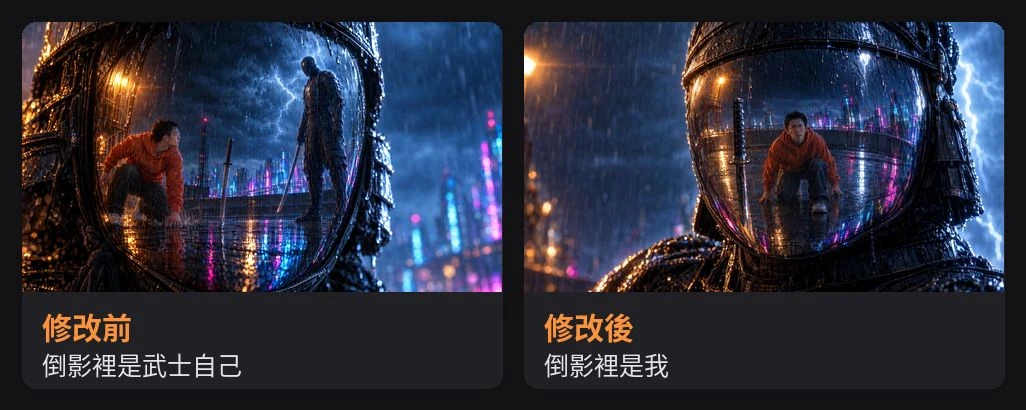
面甲倒影的提示詞
Cinematic 16:9 film still from a top-tier Hollywood sci-fi action blockbuster. The stand-off on the rain-soaked rooftop, seconds after the man landed: an extreme close-up of the samurai's helmet, seen from the front and slightly to the left.

THE HELMET: the samurai's head fills the right two-thirds of the frame, turned slightly toward the left of the frame. The front of the helmet is a smooth, seamless, convex mirror-black visor with no features at all, curving around the head like the front of a motorcycle helmet. The matte black lacquered helmet shell, its layered neck guard and the top of the armoured shoulder are visible around it. Rain beads and runs down the curved visor. This is part of a helmet worn by a person, not a window, not a frame, not a portal.

THE REFLECTION, SEEN FROM THE SAMURAI'S POSITION: the convex visor reflects only what is in front of the samurai, bent like a fisheye mirror, strongly compressed and curved toward the edges. In the centre of the visor, small: the man crouched on the wet rooftop, seen from the front, facing the camera, his face tilted up looking straight at the samurai, his soaked dark-orange hoodie the only orange in the frame, both sleeves intact. Closer to the visor and larger, curving with the surface: the katana standing upright in the concrete between them. Behind the man, bent along the curve: the low parapet, the water tower with its warm sodium floodlight as one bright point, and the cyan and magenta glow of the city. The samurai himself does not appear in the reflection.

LIGHT, FOLLOWING THE CITY MAP: lightning flashing behind the samurai rims the edges of the helmet and shoulder in hard blue-white light; the warm sodium floodlight from the upper left lays a soft warm highlight across the visor; cyan and magenta city glow rises along its lower edge.

BACKGROUND: the left third of the frame is out-of-focus rain and the dark storm sky.

CAMERA: 100 mm, f/2.8, shallow depth of field, focus on the reflection in the visor.

AVOID: the samurai or any armoured figure inside the reflection, a second person, the man in profile, a flat mirror, an oval window, a frame, a portal, a magnifying glass, any face, eyes, mouth or features on the visor, the man's torn sleeve, recognisable film characters, readable text, blood, watermark.

WORLD MAP, CITY: a futuristic megacity at the blue hour under a heavy storm. The sun is hidden above thick storm clouds; the sky is deep blue, never black and never bright. Heavy rain falls almost vertically, drifting slightly from left to right. On the rooftop, the key light is always one warm sodium floodlight mounted high on a water tower on the left side of the rooftop; lightning always flashes behind the samurai as a blue-white backlight; cyan and magenta city glow always rises from below the edge of the roof. The man is always on the left facing right and the samurai on the right facing left. From the moment he enters the cloud, the man is completely soaked; from the sword clash on, his right sleeve is slashed open.

REALISM AND MATERIALS: this must look like a frame photographed on a real film set and finished by a top VFX house, never like a digital render or an AI image.
- Skin: real human skin with visible pores, fine peach fuzz, natural unevenness, subsurface scattering on ears and fingers; wet skin shows real water beads and sheen. No plastic, waxy or airbrushed skin.
- Fabric: the hoodie is heavy cotton fleece with visible knit texture and ribbed cuffs. When dry it is bright orange and fluffy; when wet it darkens, becomes heavy, clings to the body, forms tight folds and drips water. A slashed sleeve shows frayed cotton fibres along a clean cut. The jeans are rigid washed denim with visible twill weave; wet denim turns darker and stiff.
- Hard surfaces: concrete shows texture, cracks and puddles with real reflections; lacquered armour shows micro-scratches and water beading; steel blades show real polish, nicks and reflections; glass shards have real thickness, sharp edges and refraction; clouds are real volumetric vapour.
- Water and weather: rain falls as individual streaks with correct motion blur; splashes form real crowns; puddles ripple; sleet and snow behave as real particles; lightning lights the scene with a real, hard, momentary light.
- Physics: everything has believable mass, inertia and gravity. Impacts transfer energy: water explodes, concrete cracks, sparks fly in arcs and fade. Wind and rain directions stay consistent within a shot.
- Light: physically based light with real falloff, bounce light and colour temperature; every light has a visible, motivated source; true deep blacks without crushed detail.
- Lens and film: a real cinema lens with subtle chromatic aberration at the edges, natural vignetting, real bokeh, physically accurate lens flare, organic film grain and gentle halation on highlights.
- AVOID: CGI sheen, video-game look, oversaturated colours, HDR glow, over-sharpening, smooth plastic surfaces, cartoon proportions, floating objects with no weight, physically impossible lighting.袖子破洞:有幾張圖破洞跑到別處,後面每張都統一成右前臂。
劃破袖子的提示詞
Cinematic 16:9 film still from a top-tier Hollywood sci-fi action blockbuster. Macro slow-motion frame, a split second before the blades lock: the samurai's katana slices across the man's soaked right forearm sleeve.

COMPOSITION: the man's right forearm, in the soaked dark-orange hoodie sleeve, enters from the left edge of the frame at the elbow and runs diagonally down toward the lower right corner, leaving the frame before the wrist; his hand and his own katana are out of frame beyond the lower right corner. At the upper right edge of the frame, the samurai's black lacquered armoured gauntlets grip the dark cord-wrapped handle of his katana. From the samurai's hands, his blade reaches down toward the left, and its edge cuts across the top of the sleeve in the lower half of the forearm. The blade clearly belongs to the samurai.

DETAIL: the soaked fleece is half cut along a clean line, frayed cotton fibres separating one by one, water droplets bursting off the fabric and hanging frozen in the air. The steel shows real polish, small nicks and rain beads. Only the fabric is cut: no blood, no wound.

SLOW MOTION: raindrops hang almost frozen around the blade, each one catching the light.

LIGHT, FOLLOWING THE CITY MAP: the warm sodium floodlight from the upper left glints along the blade edge and lights the wet fleece; a blue-white lightning rim from behind on the right; faint cyan and magenta glow from below. No sparks yet.

CAMERA: 100 mm macro, f/4, focus on the cut fibres, the background dissolving into rain and city bokeh.

AVOID: the man's hand, the man's own katana, a sword handle or guard near the man's arm, the man's face, blood, a wound, cut skin, sparks, a dry sleeve, extra fingers, distorted hands, readable text, watermark.

WORLD MAP, CITY: a futuristic megacity at the blue hour under a heavy storm. The sun is hidden above thick storm clouds; the sky is deep blue, never black and never bright. Heavy rain falls almost vertically, drifting slightly from left to right. On the rooftop, the key light is always one warm sodium floodlight mounted high on a water tower on the left side of the rooftop; lightning always flashes behind the samurai as a blue-white backlight; cyan and magenta city glow always rises from below the edge of the roof. The man is always on the left facing right and the samurai on the right facing left. From the moment he enters the cloud, the man is completely soaked; from the sword clash on, his right sleeve is slashed open.

REALISM AND MATERIALS: this must look like a frame photographed on a real film set and finished by a top VFX house, never like a digital render or an AI image.
- Skin: real human skin with visible pores, fine peach fuzz, natural unevenness, subsurface scattering on ears and fingers; wet skin shows real water beads and sheen. No plastic, waxy or airbrushed skin.
- Fabric: the hoodie is heavy cotton fleece with visible knit texture and ribbed cuffs. When dry it is bright orange and fluffy; when wet it darkens, becomes heavy, clings to the body, forms tight folds and drips water. A slashed sleeve shows frayed cotton fibres along a clean cut. The jeans are rigid washed denim with visible twill weave; wet denim turns darker and stiff.
- Hard surfaces: concrete shows texture, cracks and puddles with real reflections; lacquered armour shows micro-scratches and water beading; steel blades show real polish, nicks and reflections; glass shards have real thickness, sharp edges and refraction; clouds are real volumetric vapour.
- Water and weather: rain falls as individual streaks with correct motion blur; splashes form real crowns; puddles ripple; sleet and snow behave as real particles; lightning lights the scene with a real, hard, momentary light.
- Physics: everything has believable mass, inertia and gravity. Impacts transfer energy: water explodes, concrete cracks, sparks fly in arcs and fade. Wind and rain directions stay consistent within a shot.
- Light: physically based light with real falloff, bounce light and colour temperature; every light has a visible, motivated source; true deep blacks without crushed detail.
- Lens and film: a real cinema lens with subtle chromatic aberration at the edges, natural vignetting, real bokeh, physically accurate lens flare, organic film grain and gentle halation on highlights.
- AVOID: CGI sheen, video-game look, oversaturated colours, HDR glow, over-sharpening, smooth plastic surfaces, cartoon proportions, floating objects with no weight, physically impossible lighting.2. 12 秒多鏡頭對決
「把落地、對峙、交手和最後一刀,放進同一段 12 秒的多鏡頭視頻。」
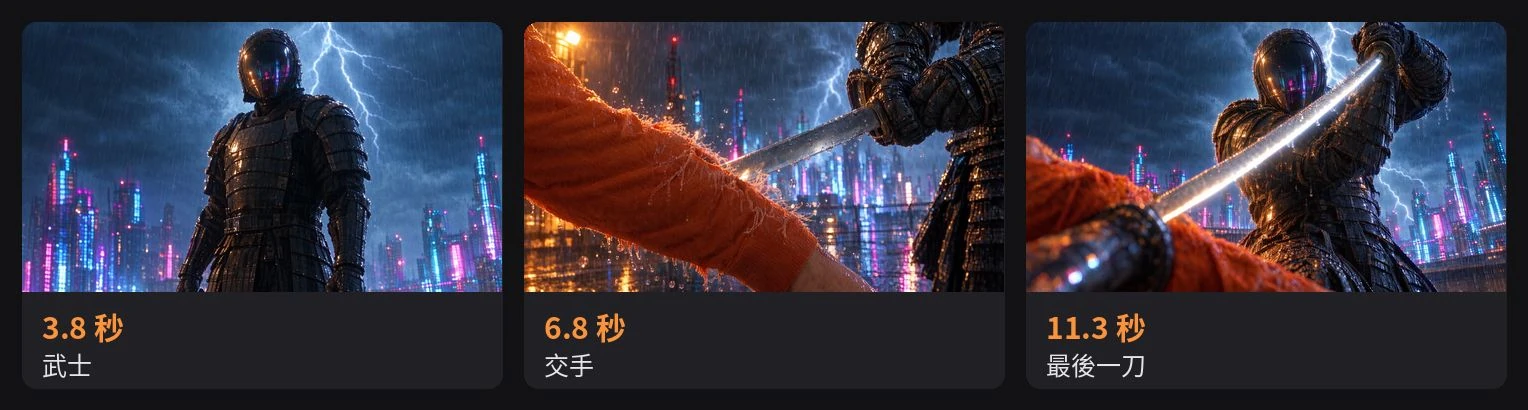
屋頂對決的提示詞
A 12-second multi-shot action sequence with hard cuts, Hollywood blockbuster samurai duel on a skyscraper rooftop in a storm, photoreal. The same man in every shot: the person in @Image 7, spiky black hair, thin round metal glasses, soaked dark-orange hoodie, soaked charcoal-black wide-leg jeans, white sneakers. The samurai: an original design, matte black lacquered armour over a black tactical suit, a smooth seamless mirror-black visor with no features; his face is never visible.

SHOT 1, 0.0–1.5 s: continuing the dive from @Image 1, about twenty metres above the roof he flips in mid-air from head-first to feet-first and slams down onto the wet concrete on one knee and one fist. A crown of water explodes outward, cracks spread through the concrete, the frame shakes on impact.
SHOT 2, 1.5–3.0 s (hard cut, low side angle as in @Image 3): he lifts his head. Across the roof, the samurai stands perfectly still in the rain. Between them, a katana stands upright, driven into the concrete.
SHOT 3, 3.0–5.0 s: three lightning flashes, a hard cut on each flash, each one closer: a wide shot of the two of them, then a medium shot of the samurai, then an extreme close-up of his mirror-black visor reflecting the man, as in @Image 4.
SHOT 4, 5.0–6.5 s: the man rips the katana out of the concrete; both of them charge across the roof through the puddles.
SHOT 5, 6.5–7.5 s: slow-motion macro: the samurai's blade slices across the man's right forearm sleeve, frayed fibres and water droplets bursting, as in @Image 6. Only the fabric is cut, no blood.
SHOT 6, 7.5–9.5 s: the blades lock in a cross, a burst of orange sparks, as in @Image 5; they push apart and exchange two fast strikes.
SHOT 7, 9.5–12.0 s: the man stumbles back; from his point of view, the samurai raises his katana with both hands and swings it down diagonally straight at the camera, the blade's edge blazing as a white-hot line from upper right to lower left. End exactly on @Image 2.

WORLD MAP, CITY ROOFTOP: a futuristic megacity at the blue hour under a heavy storm; the sky is deep blue, never black. The rooftop is the flat top of the tallest tower. In any shot showing both of them, the man is on the left facing right and the samurai on the right facing left. The water tower with its single warm sodium floodlight stands on the man's side of the roof, behind him: in side shots it is at the left of the frame; when the camera looks from the man toward the samurai, the floodlight is behind the camera and lights the front of the samurai in warm amber. The antenna mast with a blinking red light stands at the far edge of the roof. Lightning always flashes behind the samurai. Cyan and magenta city glow rises from below the parapet. Rain falls almost vertically, drifting slightly from the man's side toward the samurai's side. The man is soaked throughout; his right forearm sleeve is intact until shot 5 and slashed from shot 5 onward.

SOUND: no music. Impact boom on the landing, then only rain; a thunder crack on each lightning cut; the scrape of the katana leaving the concrete; splashing footsteps; fabric tearing; metal clang and sparks; a sharp whoosh on the final strike.

AVOID: blood, wounds, the samurai's face, recognisable film characters, the man on the right side in two-shots, the water tower visible when looking toward the samurai, a torn sleeve before shot 5, readable text, extra limbs, distorted hands, watermark, music.
3. 刀光變成裂縫,回到書桌

這一段的提示詞
An 8-second sequence, cinematic, photoreal, two shots with one hard cut. The same man throughout: the person in @Image 6, spiky wet black hair, thin round metal glasses, soaked dark-orange hoodie with the right forearm sleeve slashed, charcoal-black jeans.

SHOT 1, 0.0–2.2 s, from the monitor's point of view: the film image has shattered along the diagonal line of the blade. The glass shards, each still showing fragments of the rooftop duel, fall away from the camera, and every shard dissolves into fine points of light before it touches anything; nothing lands in the room. Through the gaps the man is revealed sitting at his desk in a dark apartment at 3 a.m., facing the camera, soaked, breathing hard, eyes wide, water dripping from his chin, as in @Image 3. By 2.0 s all shards are gone.

SHOT 2, 2.2–8.0 s (hard cut, over his right shoulder): the intact monitor shows the Claude app in conversation view, exactly in the design of @Image 5. The camera pushes in slowly toward the screen throughout the shot and ends exactly on @Image 2.
- From the first frame of this shot, his earlier message 「幫我拍一部動作片,主角是我。」 is already there in a bubble at the top right. Below it, the small orange Claude logo.
- 2.6–4.2 s: Claude's reply streams in on the left, character by character like a live Claude response: first "Cut." by 3.1 s, then 「這一條要重拍嗎?」 by 4.2 s, exactly as in @Image 4.
- 4.2–5.0 s: he freezes, then his shoulders drop as he lets out a long breath, and he leans slightly toward the screen.
- 5.0–6.6 s: his wet fingers type. In the input box at the bottom, the characters of 「再拍一次。」 appear one by one, in sync with his key presses.
- 6.8 s: he presses Enter. 「再拍一次。」 appears as a new bubble on the right, below Claude's reply, and the small orange Claude logo appears below it. The input box is empty again.
- 7.0–8.0 s: the screen's light surges brighter and brighter, spilling onto his hand and hair, as if the screen is about to pull him in again. End exactly on @Image 2.

TEXT RULES: every character must match @Image 4 and @Image 2 exactly. Text appears only at the moments described and never changes afterwards. The interface keeps exactly the design of @Image 5 and never changes style.

WORLD MAP, DESK: a small dark Japanese apartment at 3 a.m., all room lights off; the screen is the only strong light. Behind him on his left is a rain-streaked window with purple and cyan city bokeh; behind him on his right is a dark bookshelf. Beyond the monitor is a plain dark wall with no window. A coffee mug stands on the desk to the right of the keyboard. The monitor is never broken: the shattering is the film image, not the real screen.

SOUND: no music. At 0.0 s total silence for one beat, then only the rain on the window and his hard breathing; a single water drop hitting the desk; a very soft, quick ticking while the reply streams in; his long exhale; soft keyboard clicks while he types; one heavier click on Enter at 6.8 s; then a low hum rising fast with the surging light.

AVOID: a generic or redesigned chat interface, a distorted Claude logo, garbled characters, text appearing all at once, extra text, the home screen, shards landing in the room, a broken monitor, blood, a dry hoodie, an intact right sleeve, a window behind the monitor, extra fingers, distorted hands, watermark, music.
4. 片尾的對話框,也是生成的
「參考真實界面,把工具記錄和結局對話做成關鍵圖,再生成動態。」
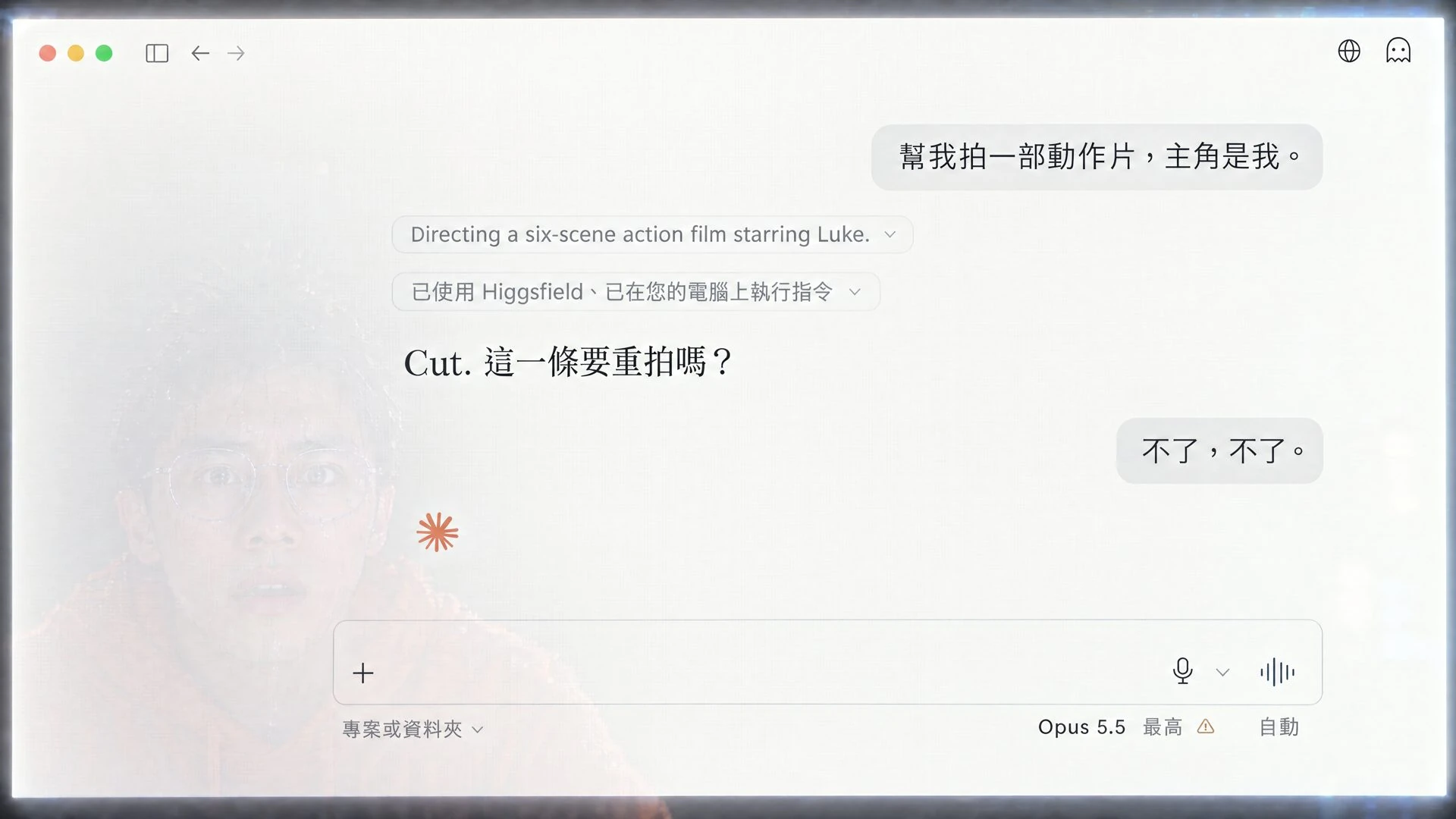
關鍵圖的提示詞
Photoreal 16:9 frame, shot straight on at a computer monitor so close that the screen fills the entire frame edge to edge, exactly as in @Image 1. The screen shows the Claude desktop app in conversation view, in the light theme and design of @Image 1 and @Image 2: the same window with the three traffic-light buttons, the same warm off-white background, the same fonts, the same orange Claude logo, the same input box with its icons. Below the input box, the small labels exactly as in @Image 2: 「專案或資料夾」 on the left; 「Opus 5.5」「最高」 and 「自動」 on the right.
Claude's thinking line and tool activity are styled exactly like @Image 3, converted to the light theme: grey text on the off-white background, thin light-grey outlines, small chevrons.
REAL SCREEN: a very fine, barely visible pixel texture. On the glass, a very faint, ghost-like reflection of his face seen from the front, as in @Image 4: wet spiky hair, thin round metal glasses, wide shocked eyes, the soaked orange hoodie at the bottom. Place it slightly left of centre in the lower half, at about one-tenth opacity, behind the interface, never covering any text.
Spell all text exactly as written, including punctuation, spaces and capital letters. No other text in the conversation. All text is crisp and easy to read.
AVOID: the back of his head, a strong reflection, a dark-theme interface, a room or desk visible around the screen, a redesigned or generic interface, a distorted Claude logo, two Claude logos, changed or extra characters, 「專業或資料夾」, simplified Chinese characters, moiré, watermark.

THE CONVERSATION, from top to bottom, with comfortable spacing:
1. On the right, his first message in a soft light-grey rounded bubble: 「幫我拍一部動作片,主角是我。」
2. On the left, Claude's collapsed thinking line in grey, followed by a small down chevron: 「Directing a six-scene action film starring Luke.」
3. On the left, Claude's collapsed tool activity: a single grey line 「已使用 Higgsfield、已在您的電腦上執行指令」 followed by a small down chevron. No rows are shown.
4. On the left, below it, with no bubble, Claude's reply in the serif font of the greeting in @Image 2: 「Cut. 這一條要重拍嗎?」
5. On the right, his second message in the same bubble style: 「不了,不了。」
6. On the left just below his second message, one small orange Claude logo. There is only one Claude logo on the screen.
7. At the bottom, the input box, empty.
The screen glows brighter than normal, as if its light is starting to surge, with a gentle bloom at the edges, but every character stays sharp.
視頻的提示詞
A 10-second sequence, cinematic, photoreal, two shots with one hard cut. The same man throughout: the person in @Image 7, spiky wet black hair, thin round metal glasses, soaked dark-orange hoodie with the right forearm sleeve slashed, charcoal-black jeans.

SHOT 1, 0.0–2.0 s, from the monitor's point of view: the film image has shattered along the diagonal line of the blade. The glass shards, each still showing fragments of the rooftop duel, fall away from the camera, and every shard dissolves into fine points of light before it touches anything; nothing lands in the room. Through the gaps the man is revealed sitting at his desk in a dark apartment at 3 a.m., facing the camera, soaked, breathing hard, eyes wide, water dripping from his chin, as in @Image 3. By 1.8 s all shards are gone.

SHOT 2, 2.0–10.0 s (hard cut), one continuous camera move:
- 2.0–3.4 s: the shot starts over his right shoulder, as in @Image 4: the back of his wet head, his hand on the keyboard, the monitor glowing with the Claude app. On the screen, only his message 「幫我拍一部動作片,主角是我。」 in a bubble at the top right, and the small orange Claude logo below it, gently pulsing as Claude thinks. The camera glides forward past his shoulder and swings around to face the screen straight on; his head and shoulder slide out of the frame to the left. The camera keeps pushing in until, by 3.4 s, the screen fills the entire frame edge to edge. From here on, only a very slow push-in, and a faint reflection of his face on the glass.
- 3.4 s: Claude's grey thinking line appears below his message: 「Directing a six-scene action film starring Luke.」
- 3.6–5.2 s: below it, the tool activity appears, expanded, exactly as in @Image 5: the header 「已使用 Higgsfield、已在您的電腦上執行指令」, then the eight rows pop in one at a time, about every 0.2 seconds, top to bottom: 「已在您的電腦上執行指令」, 「已使用 Higgsfield Upload Media」, 「已使用 Higgsfield Show Characters」, 「已使用 Higgsfield Generate Image」, 「已使用 Higgsfield Generate Video」, 「已使用 Higgsfield Wait For Generation Jobs」, 「已使用 Higgsfield Check Balance」, 「已在您的電腦上執行指令」. The last row shows a small spinning loader.
- 5.2–5.5 s: the loader finishes and the whole tool box collapses smoothly into its single header line, as in @Image 2.
- 5.5–6.6 s: Claude's reply streams in below, character by character like a live Claude response: first "Cut." then 「這一條要重拍嗎?」. The reply is completely finished at 6.6 s. While the reply is streaming, the input box stays completely empty and nothing else on the screen changes.
- 6.6–7.2 s: a full pause. Nothing on the screen moves. The finished reply sits there; in the reflection, his face is frozen, staring.
- 7.2–8.4 s: only now, after the pause, he starts typing. In the input box at the bottom, 「不了」 appears one character at a time; a hesitant pause; then 「,不了。」 appears quickly.
- 8.6 s: the message is sent: 「不了,不了。」 appears as a new bubble on the right, below Claude's reply. The orange Claude logo moves to just below his new message; there is only ever one Claude logo on the screen. The input box is empty again.
- 8.8–10.0 s: despite his answer, the whole screen's light surges brighter, as if it is about to pull him in again; in the reflection on the glass, his face jerks back in shock. End exactly on @Image 2.

TEXT RULES: the events on the screen happen strictly one after another, never at the same time: thinking line, tool rows, collapse, Claude's reply, pause, his typing, his sent message. His typing must not start until Claude's reply is completely finished and the pause is over. Every character must match @Image 5 and @Image 2 exactly. Text appears only at the moments described and never changes afterwards. The interface keeps exactly the design of @Image 6 and never changes style. Only one Claude logo is on the screen at any time.

WORLD MAP, DESK: a small dark Japanese apartment at 3 a.m., all room lights off; the screen is the only strong light. Behind him on his left is a rain-streaked window with purple and cyan city bokeh; behind him on his right is a dark bookshelf. Beyond the monitor is a plain dark wall with no window. A coffee mug stands on the desk to the right of the keyboard. The monitor is never broken: the shattering is the film image, not the real screen.

SOUND: no music. At 0.0 s total silence for one beat, then only the rain on the window and his hard breathing; a single water drop hitting the desk; a soft tick as each tool row pops in, faster and faster; a soft click as the tool box collapses; very soft, quick ticking while the reply streams in; during the pause, total silence except the rain and his caught breath; then hesitant keyboard clicks, a pause, and fast clicks; one hard click on Enter at 8.6 s; then a low hum rising fast with the surging light, and his chair creaking as he jerks back.

AVOID: typing while Claude's reply is still appearing, text in the input box before 7.2 s, two things changing on the screen at the same time, a generic or redesigned chat interface, a dark-theme interface, a distorted Claude logo, two Claude logos, garbled characters, text appearing all at once, the reply appearing before the tool box collapses, extra text, the home screen, shards landing in the room, a broken monitor, blood, a dry hoodie, an intact right sleeve, a window behind the monitor, extra fingers, distorted hands, watermark, music.省點數的 5 個訣竅
- 先寫好故事和分鏡,再開始生成。 試錯最貴的是做到一半推倒重來。
- 關鍵畫面直接用 GPT Image 2.5,不用每個模型都試。
- 視頻先出 480p 草稿,滿意再用同一份草稿升級 1080p,動作不會變。
- 鏡頭一多,先寫世界設定:方向、光線、人物位置都先固定。
- 小瑕疵在剪輯裡修。 太慢就加速,接不上就加轉場,不一定要重新生成。
已發佈指南記錄的這支預告花費約 3,238 點,包含試錯。按這篇的順序做,可以省去其中不少試錯;這並非每個人復現時的固定預算。